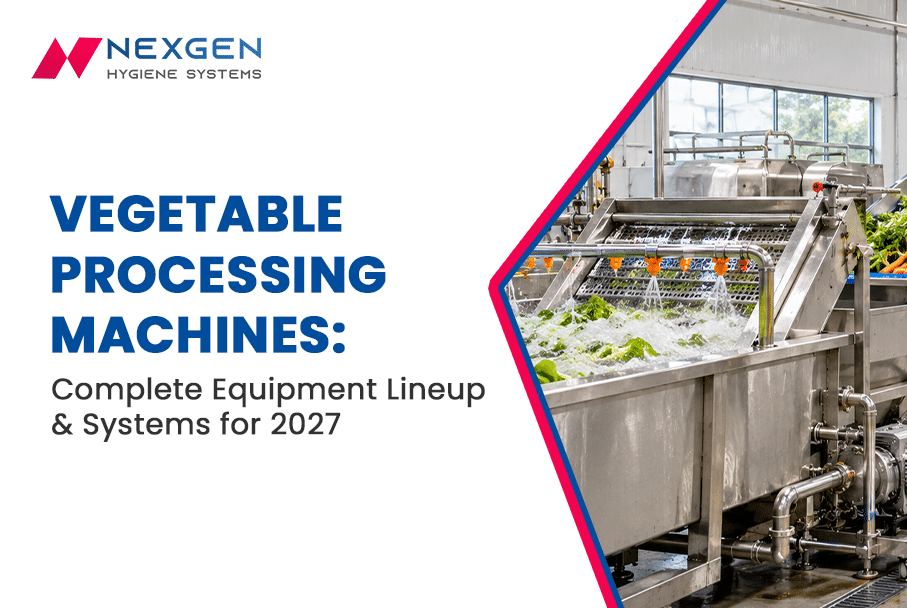
Vegetable processing involves more than washing and cutting raw produce. Depending on the final product, manufacturers may need peeling, dicing, slicing, chopping, drying, and material-handling equipment at different stages of production.
Choosing these machines individually without considering how they work together can lead to unnecessary handling, bottlenecks, and an inefficient production workflow.
At Nexgen, we supply vegetable processing equipment for different production requirements, from individual machines to integrated processing setups.
This guide covers the machines used across different processing stages, their applications, and how to select the right equipment lineup for your facility.
What Does a Vegetable Processing Line Include?
A vegetable processing line brings together the machines used to prepare raw vegetables for further processing, cooking, freezing, or packaging.
The exact sequence depends on the vegetable and finished product, but a typical workflow may include:
Raw material preparation: Sorting and preparing vegetables before processing.
🔽
Washing: Removing soil and unwanted material from the produce.
🔽
Peeling: Removing skins or outer layers of vegetables that require peeling.
🔽
Cutting and preparation: Dicing, slicing, chopping, or cutting vegetables into the required size.
🔽
Drying: Removing surface moisture or further drying the product, depending on the application.
🔽
Material handling: Moving vegetables between machines and processing stages.
🔽
Further processing and packaging: Preparing the product for cooking, freezing, mixing, or packaging.
Not every facility will need all of these stages. A plant that needs diced veggies for supplies only needs washing and cutting equipment, whereas another that uses onions or garlic requires a peeling stage before the rest of the process.
The equipment required should be in line with the product being made and the operations necessary to make that product.
Vegetable Processing Machines by Processing Stage
Each piece of machinery in a vegetable processing line has a particular job to do. Knowing what those jobs are makes it far easier to select the right equipment for your particular production needs rather than just buying machines that may not actually be appropriate for your process.
1. Vegetable Washing Machines
Washing is usually the first stage in vegetable processing. The machine needs to handle the type of produce being processed and the volume required by the production line.
Our vegetable washer range includes:
- Tilting vegetable washer: Designed for batch washing, with a tilting arrangement that makes unloading easier.
- Multipurpose vegetable washer: Used to wash different vegetables based on the machine’s operating requirements.
The choice between these machines depends on the vegetables being handled, production volume, and how the washed produce moves to the next stage.
For example, if washed vegetables are going directly to a dicing machine, unloading and transferring them efficiently becomes an important part of the workflow.
Explore our vegetable washing machines to find equipment for your processing requirements.
2. Vegetable Peeling Machines
Vegetables such as onions and garlic will require peeling prior to cutting, chopping, or any further processing. As their skins and handling are going to be different, the appropriate peeling equipment will have to be selected for the raw material.
Our peeling equipment includes:
- Onion peeling machine: Removes the outer skin of onions during preparation.
- Garlic peeling machine: Peels garlic cloves before further processing.
Peeling equipment is particularly useful when manual peeling becomes time-consuming at commercial production volumes. Selecting the right machine also means considering the incoming raw material, output requirement and the next processing stage.
Explore our vegetable processing machines for available peeling equipment.
3. Vegetable Cutting, Dicing and Slicing Machines
Cutting equipment is selected on the basis of the size and shape required in the finished product. The equipment used to produce dices, slices, strips, and chops is not interchangeable.
Our vegetable cutting equipment includes:
- Vegetable dicing machine: For producing uniform vegetable cubes and other supported cuts, including slicing and strip cutting, depending on configuration.
- Leafy vegetable cutting machine: For cutting leafy vegetables used in food preparation and processing.
- Chopping machine: For chopping vegetables and ingredients used in mixes, preparations, and food bases.
For ready-to-cook products, frozen vegetables, and food ingredients, the required cut can influence machine selection and the processing sequence.
Our vegetable dicing machine is designed for multiple cutting operations, including dicing, slicing, and strip cutting, with the configuration selected for the application.
4. Vegetable Chopping Machines
Chopping machines are used when you need to get your veg (or other ingredients) down to a smaller size for further processing. They’re used for the ingredients in food mixes, pastes, bases, and so on.
Unlike dicing and slicing machines that produce defined cuts, chopping equipment is used when the required output is chopped ingredients.
Machine selection depends on the material being processed, the required output, and the next stage of production.
5. Vegetable Drying and Moisture Removal Equipment
Some vegetable processing operations will require moisture removal following washing or other processing. This could be as simple as removing the surface moisture prior to packaging, or it could be the removal of moisture as part of the processing itself.
Our food-processing equipment includes options such as:
- Centrifugal dryer: Removes surface moisture from suitable processed products.
- Tray dryer: Used for applications that require tray-based drying.
- Air knife drying systems: Use directed air to remove surface moisture from suitable products or packaging applications.
These machines serve different drying requirements. The choice depends on the product, the moisture-removal objective, and the subsequent process.
6. Conveyors and Material Transfer Equipment
Material movement between machines can affect the output of an entire processing line. Even when individual machines have sufficient capacity, manual transfers and poorly arranged workstations can slow production.
Conveyors help move vegetables between processing stages and can be incorporated into a line to reduce unnecessary manual handling.
They are useful when:
- Vegetables need to move between multiple machines.
- Processing stages are positioned at different points in the facility.
- Manual material transfers are slowing down production.
- The plant needs a more structured flow from one operation to the next.
Conveyor selection and positioning should be considered in conjunction with the machines to ensure the whole workflow is viable.
Which Vegetable Processing Machines Do You Need?
The machines required for commercial vegetable processing are largely a function of the product and the operations that are required.
| Processing Requirement | Equipment |
| Washing raw vegetables | Vegetable washer |
| Removing onion skins | Onion peeling machine |
| Peeling garlic cloves | Garlic peeling machine |
| Producing vegetable cubes | Vegetable dicing machine |
| Slicing vegetables | Vegetable slicing machine |
| Cutting leafy vegetables | Leafy vegetable cutter |
| Chopping ingredients for mixes and bases | Chopping machine |
| Removing surface moisture | Suitable drying or moisture-removal equipment |
| Moving vegetables between stages | Conveyor or material transfer system |
This is just a starting point for equipment selection rather than a set production sequence.
A facility processing only a handful of products may well end up with a very compact setup, whereas a plant which is processing a range of vegetables and a range of finished products may well have a number of machines in operation.
Vegetable Processing Equipment for Different Production Requirements
The equipment lineup changes according to what your facility produces. A manufacturer preparing vegetables for ready-to-cook packs has different requirements from one supplying frozen vegetables or ingredients for food preparations.
Fresh-Cut and Ready-to-Cook Vegetables
Fresh-cut and ready-to-cook production typically involves washing, peeling selected vegetables and cutting them into the required sizes.
The lineup can include vegetable washers, peeling machines, dicing machines, slicing machines, and conveyors. The combination depends on the vegetables processed and whether the finished product is diced, sliced, or prepared in another form before packaging.
Frozen Vegetable Processing
Frozen vegetable manufacturers need to prepare raw material before it moves to the freezing stage. Washing, peeling, dicing, slicing, and other preparation operations form part of this process.
Select processing equipment based on the product mix and production requirements, and align the preparation line capacity with downstream freezing and packaging operations.
Vegetable Ingredients for Food Preparation
Manufacturers producing ingredients for gravies, pastes, mixes, and other food preparations often require washing, peeling, and chopping equipment.
Machines are selected based on the ingredients handled and the size or texture required before the material moves to mixing, cooking, or further processing.
Multi-Product Vegetable Processing Facilities
Facilities handling different vegetables on the same production line need to account for product compatibility, cleaning, changeovers, and handling between operations.
The objective is to build a lineup that supports the range of products being processed without unnecessarily complicating the workflow.
Individual Machines vs an Automated Vegetable Processing Line
Buying individual machines for specific operations is different from planning an automated vegetable processing line.
| Individual Machines | Integrated Processing Line |
| Selected for specific operations | Selected around the complete production workflow |
| Suitable for focused requirements or phased investment | Suitable when several processing stages need to work together |
| Transfers between machines may require manual handling | Material transfers can be planned as part of the line |
| Equipment can be added as production expands | Equipment capacity and layout need coordinated planning |
An integrated setup is more than a group of machines placed side by side. Washing, peeling, cutting, and subsequent handling stages need to work in a coordinated sequence.
A complete vegetable processing system should therefore be planned around the raw material, required output, processing sequence, and facility layout.
How Vegetable Processing Automation Helps
Vegetable processing automation can reduce repetitive manual operations and make material movement between processing stages more organised.
For example, connecting washing and cutting stages can reduce the need to manually transfer vegetables between separate workstations. However, the line still needs to be designed around the capacity of each machine. If one stage cannot keep up with the previous operation, it can become a bottleneck.
The benefits of vegetable processing automation depend on how you select and integrate equipment across the workflow, not simply on how many machines you automate.
Get the Right Machines for Your Vegetable Processing Needs
Not sure which machines your production process requires? Tell us what vegetables you process and what you want to produce. We’ll help you identify the equipment that fits your requirements.
How to Plan Your Vegetable Processing Equipment Lineup
Before purchasing machines, define what your processing line needs to accomplish. This helps you select the right equipment and avoid unnecessary machinery or mismatched capacities.
1. Define the Finished Product
Start with the product you intend to manufacture. Diced vegetables, sliced produce, leafy vegetable preparations, and ingredients for food mixes can require different machines and processing sequences.
2. Map the Processing Stages
List each operation from raw material preparation to the finished product. Identify where washing, peeling, cutting, chopping, drying, and material transfer are required.
3. Establish Your Production Requirement
Determine how much raw material needs to be processed per hour or per shift. Consider batch sizes, peak production, and the time required for loading, unloading, cleaning, and changeovers.
4. Match Machines to Each Operation
Select equipment according to the operation it performs. A dicing machine, leafy vegetable cutter, and chopping machine serve different requirements, even though all involve cutting or reducing vegetables.
5. Check Capacity Across the Line
The output of one machine needs to match the processing requirement of the next. Otherwise, one stage may become a bottleneck while other machines remain underutilised.
6. Plan the Layout and Material Movement
Account for machine positioning, transfers, utilities, cleaning access, and space for employees to operate and maintain the equipment.
7. Decide Between Individual Equipment and a Turnkey Setup
If several processing stages need to work together, consider planning and supplying the equipment as a connected system. A turnkey vegetable processing solution can be useful when machine selection, workflow, and integration need to be coordinated as one project.
What Affects the Cost of Vegetable Processing Equipment?
The cost of vegetable processing equipment depends on the machines selected and the scope of the setup.
The main factors include:
- Number and type of machines
- Processing capacity
- Automation level
- Machine construction and configuration
- Conveyors and material transfer requirements
- Installation and integration
- Customisation and facility layout
A setup requiring a washer and dicing machine will have different investment requirements from a facility handling washing, peeling, multiple cutting operations, drying, and material transfer.
For a broader understanding of equipment investment, see our food processing plant setup cost guide, which covers the factors involved in planning a food-processing facility.
Build Your Vegetable Processing Line Around Your Product
There is no universal equipment lineup for vegetable processing. A manufacturer preparing frozen vegetables, ready-to-cook ingredients, or chopped vegetables for further preparation will need a different combination of machines.
Start with the product and work backwards through the processing stages. Consider washing, peeling, cutting, chopping, drying, and material transfer as parts of the same workflow rather than separate equipment purchases.
Let’s Build the Right Processing Setup for Your Business
Whether you’re setting up a new vegetable processing facility, expanding production, or upgrading existing operations, we can help you select the right machines and plan a setup around your products, output, and workflow.
Let’s turn your processing requirements into a practical equipment solution.
FAQs
What machines are required for vegetable processing?
A sole cleaning machine focuses on the underside of footwear. A gumboot cleaning machine is designed for gumboots and may clean beyond the sole, depending on configuration. Choose based on the footwear and surfaces requiring cleaning.
Is an Automatic Shoe Cleaning Machine Necessary for Every Food Factory?
Not necessarily. The appropriate system depends on hygiene risks, footwear, and documented entry procedures. A standalone sole cleaner may suit some entry points, while others may require gumboot cleaning or an integrated hygiene station.
Does a Shoe Cleaning Machine Ensure FSSAI Compliance?
No. A machine can support footwear hygiene procedures, but compliance depends on meeting all applicable requirements in the facility’s food safety management system. Review relevant FSSAI provisions and maintain proper procedures and records.
Can a Sole Cleaning Machine Be Used in Pharmaceutical Facilities?
It may be suitable for some applications, but the decision depends on cleanliness requirements, footwear policy, and contamination-control procedures. Confirm suitability with quality and engineering teams before installation.
What Should I Check Before Buying Shoe Cleaning Equipment?
Confirm footwear compatibility, cleaning coverage, throughput, disinfection requirements, utilities, installation space, cleaning access, maintenance needs, and integration with your entry hygiene procedure.
Insights and Updates