Even a spotless food-processing machine can become a food-safety risk.
On June 15, 2026, the Food Safety and Standards Authority of India (FSSAI) issued an advisory directing food businesses to use food-grade, corrosion-resistant knives, blades, and other cutting equipment.
This advisory was for commercial kitchen cutleries, but there is also a message for food processing plants in India: the equipment that touches food must be hygiene compliant.
Therefore, the plant heads and procurement teams must choose the right food processing equipment based on:
- How safely the equipment contacts food
- How easily it can be cleaned
- Whether it stays hygienic from day one to the end of its service.
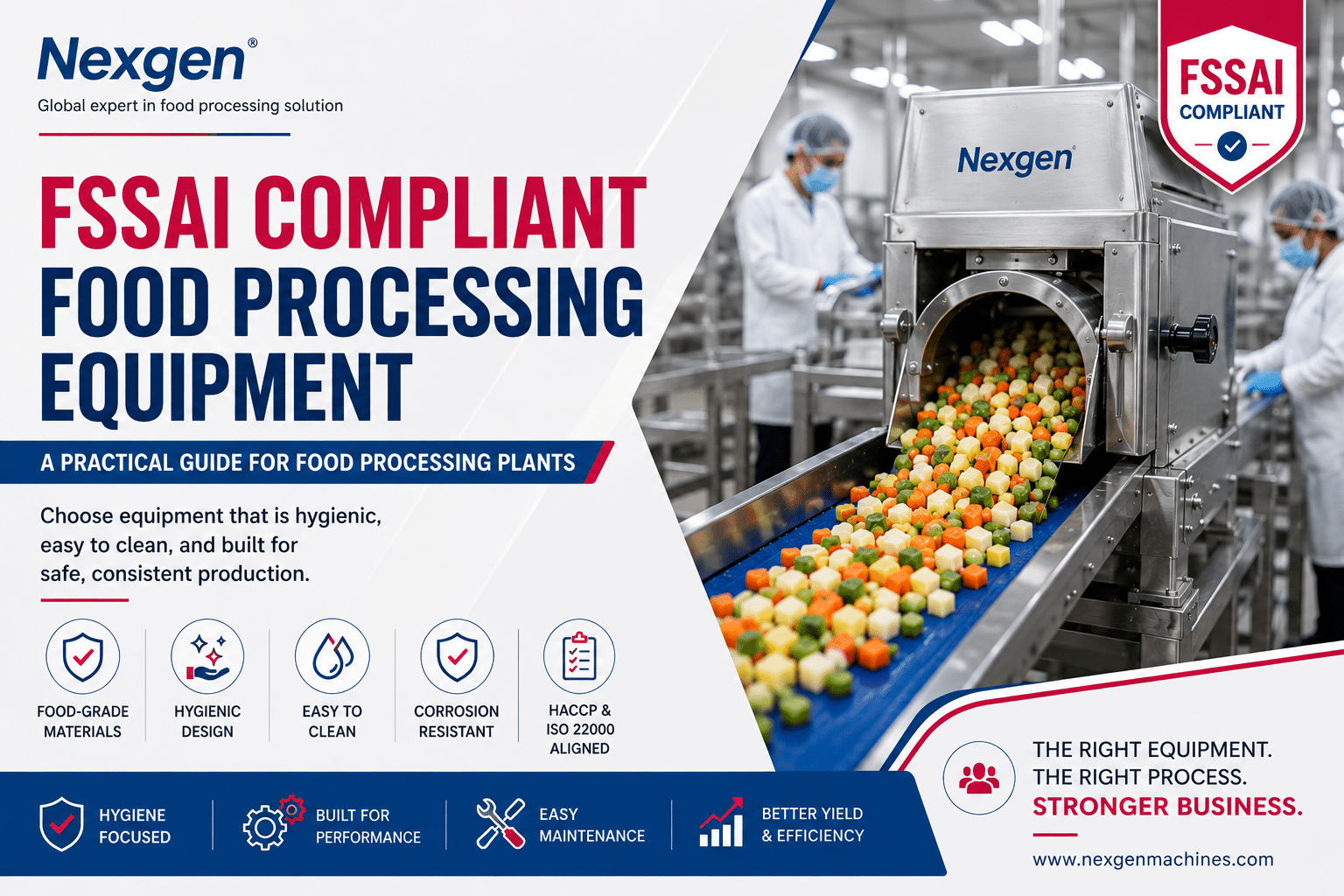
This forms the very foundation of what is called FSSAI compliant food equipment.
The Best Equipment Is Designed to Be Cleaned
FSSAI’s equipment requirements specifically connect hygienic design with the ability to clean, disinfect, and maintain equipment effectively.
In addition, equipment should remain in good repair and be free from defects that can contribute to contamination.
That’s how the procurement team must enquire before buying a processing machine: “What happens when this machine needs to be cleaned at the end of a production cycle?”
They need to consider how long it will take to reach product-contact areas, remove parts, check blades or cutting surfaces, clean away residue and get the machine running again.
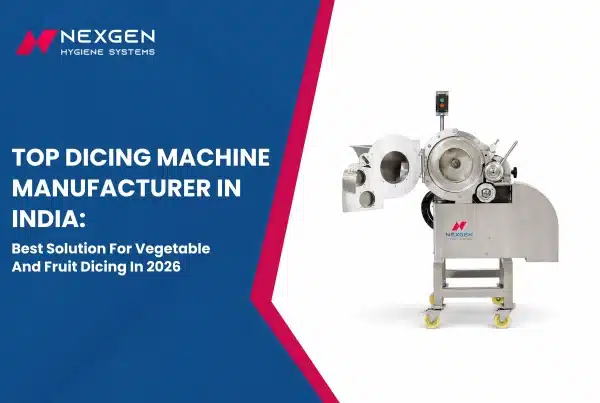
For example, Nexgen’s Vegetable Dicing Machine uses removable components and stainless-steel construction to simplify cleaning and upkeep. The machine is designed for slicing, strip cutting and dicing, with adjustable cutting sizes for different processing requirements.
Our design philosophy says, “automation must never make sanitation more difficult.”
Materials Matter; But So Does Maintenance.
Procurement teams should also evaluate the food processing equipment against the hazards identified in their plant’s food-safety system.
FSSAI describes its sector-specific Food Safety Management System guidance as being based on Schedule 4 and providing practical guidance for implementing good hygienic practices and HACCP systems.
Moreover, the Codex General Principles of Food Hygiene, CXC 1-1969, places HACCP within the broader food-hygiene framework and identifies it as a system for addressing significant food-safety hazards through appropriate controls.
Codex General Principles of Food Hygiene
HACCP, or Hazard Analysis and Critical Control Point, takes a hazard-based approach for ensuring hygiene in the food industry.
Now, for a plant manager and procurement heads, the choice of procuring food processing equipment must be based on use-cases they witness on the day-to-day processing; for example:
- If cutting is a potential contamination point, the cutting equipment needs appropriate material, design, cleaning and inspection controls.
- If washing is a critical part of the process, the washer needs to support consistent and controllable operation.
- If leftover moisture can disrupt packaging or handling later on, drying should be built into the process, not tacked on at the end.
And Where Does ISO 22000 Fit?
ISO 22000 is a food safety management system standard for organisations across the food chain. Its current published framework is ISO 22000:2018 with Amendment 1:2024, while a new ISO/DIS 22000 is under development.
Finally, here is the entire food safety compliance picture for Food businesses (processing, packaging, and commercial kitchens) who are eyeing domestic as well as export markets:
- FSSAI establishes applicable regulatory requirements in India.
- HACCP provides a systematic approach to identifying and controlling significant food-safety hazards.
- ISO 22000 provides a structured food safety management system framework.
- Equipment needs to support the controls, hygiene practices and process requirements established by the food business.
See Hygienic Design in Practice with Nexgen Food Processing Machines
From vegetable cutting and dicing to peeling and washing, explore how equipment design affects cleaning, maintenance and day-to-day processing.
Choosing the Most Hygiene Compliant Food Processing Equipment
A machine should fit the process, the people, the hygiene controls and the production goals that surround it.
Here is what procurement teams must evaluate and why they matter:
| What to check | Why it matters |
| Food-contact materials | Reduces material-related contamination risks |
| Hygienic design | Makes effective cleaning and inspection possible |
| Corrosion resistance | Supports long-term hygienic operation |
| Cleanability | Reduces residue and contamination risks |
| Maintenance access | Makes inspection and corrective action practical |
| Process controls | Helps maintain critical operating conditions |
| Capacity | Ensures the machine fits actual production requirements |
| Line integration | Prevents one faster machine from creating another bottleneck |
| Documentation | Supports SOPs, maintenance and food-safety records |
Nexgen’s food processing range includes equipment for cutting, dicing, peeling, washing and other processing operations. Its Leafy Vegetable Cutting Machine, for example, is designed for high-volume processing and includes easy maintenance and cleaning as part of its operating considerations.
Its Onion Peeling Machine is designed for automated peeling with a focus on consistent processing and reduced manual intervention.
Compliance Extends Beyond the Processing Machine
Food safety does not begin when raw material enters a cutter.
People, footwear, tools, equipment movement and production-zone access can all influence contamination control.
This is where Nexgen Hygiene Stations complement food processing equipment. They combine functions such as hand washing, sanitising, boot and shoe cleaning and access control to support hygiene at critical entry and exit points.
The same principle applies downstream.
Nexgen’s Air Knife Drying Systems are designed for contactless surface drying in food and other processing environments. Where residual moisture can interfere with subsequent handling, packaging or process consistency, controlled drying can become part of the hygiene and quality strategy.
The goal is not to pile on equipment just to tick a compliance box. Rather, it is to create a production line where equipment, hygiene routines and process controls all work in harmony.
Get the Right Equipment for Your Process and Production Goals
Your product, throughput, hygiene requirements and existing line all affect the equipment you need. Discuss your application with Nexgen before you finalise the investment.
Email: gaurav@nexgenhygiene.com
Phone: +91 96900 40048 | +91 98226 51535
FAQs
What makes food processing equipment FSSAI compliant?
To be FSSAI compliant, food processing equipment should meet food-safety and hygiene requirements through suitable food-contact materials, hygienic construction, cleanability, corrosion resistance, maintenance, and appropriate operating controls.
Which stainless steel is suitable for food processing equipment?
The appropriate stainless-steel grade depends on the product, process conditions, cleaning chemicals, temperature, and exposure to corrosive substances. Procurement teams should evaluate the actual application instead of selecting a grade just because it is commonly used in food plants.
How do I check whether food processing equipment is hygienically designed?
Check if food-contact surfaces are smooth, corrosion-resistant, and easy to clean. Inspect joints, corners, crevices, moving parts, and hard-to-reach areas where food residue or moisture could accumulate. The equipment should allow effective inspection, cleaning, and maintenance.
Does FSSAI certify food processing machines?
FSSAI’s requirements apply to food businesses and their food-safety practices. A machine should not be considered “FSSAI certified” just because a supplier uses that term. The key question is whether its design, materials, installation, and operation support the applicable food-safety requirements.
How does HACCP affect food equipment selection?
HACCP identifies significant food-safety hazards and establishes controls. Equipment should support those controls. For example, if contamination risk is linked to a processing step, the equipment should allow proper sanitation, inspection, and process control.
Insights and Updates