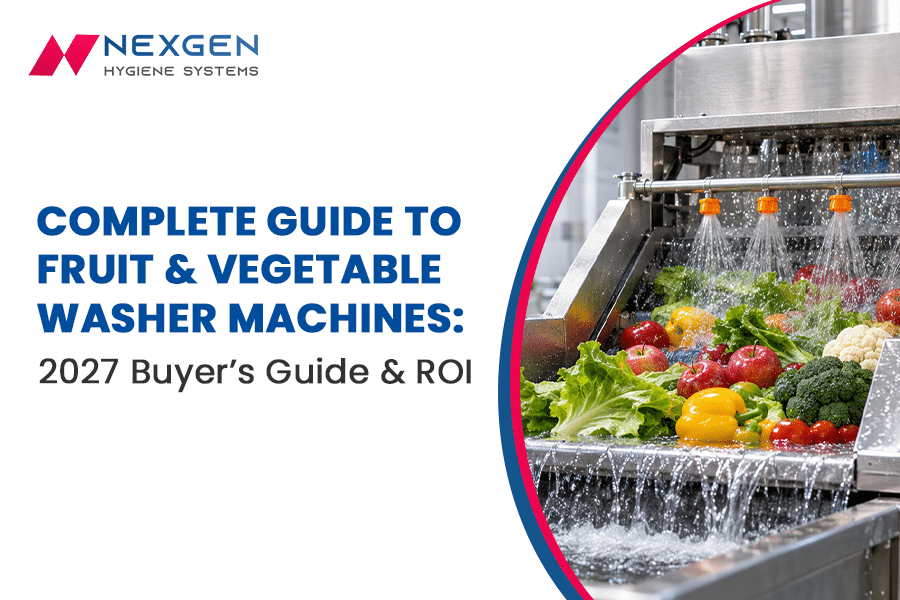
A vegetable washing machine improves cleaning consistency and reduces preparation time. However, the best equipment depends on your product type, wash volume per shift, and post-wash handling.
A central kitchen preparing ready-to-eat meals has different needs than a fruit processor supplying exporters. One may require fast batch loading and unloading, while the other may need continuous washing to match a high-volume production line.
Selecting the wrong machine can create new bottlenecks, even if washing is faster.
This guide covers the main types of fruit and vegetable washers, comparison criteria, pricing factors, and how to assess return on investment before purchase.
What Is An Industrial Fruit And Vegetable Washer?
An industrial fruit washer machine cleans produce at commercial volumes. Depending on its design, it may use water circulation, agitation, air bubbles, spray systems, or mechanical movement to remove soil and surface contaminants.
These machines are used in operations such as:
- Ready-to-eat and ready-to-cook food manufacturing
- Fruit processing and juice production
- Frozen fruit and vegetable processing
- Fresh-cut produce and packaged salads
- Central kitchens and institutional catering
- Agricultural produce handling and export preparation
The washing method must match the product. Firm root vegetables tolerate different handling than leafy greens or delicate fruits. A machine suitable for potatoes may not work for lettuce or soft berries without proper configuration.
Washing is only one aspect of food safety. Water quality, sanitation, handling, and subsequent processing also impact the final result.
Types Of Vegetable Washing Machines Compared
To compare commercial vegetable washers, start with the washing mechanism and discharge arrangement. These factors determine product compatibility, operator workflow, and production line integration.
| Washer Type | Best Suited For | Main Consideration |
| Tilting Vegetable Washer | Batch washing of bulk vegetables and mixed produce | Batch capacity, unloading speed and handling |
| Multipurpose Vegetable Washer | Operations handling different vegetables and variable production requirements | Product compatibility, cleaning and operating flexibility |
| Bubble Washer | Suitable leafy vegetables and delicate produce, when the machine is configured for gentle agitation | Control of agitation and product damage |
| Continuous Industrial Washer | High-volume operations requiring a steady flow into downstream equipment | Hourly throughput, feeding and discharge integration |
These are functional categories; not all manufacturers offer identical designs. Features and suitability vary by machine.
1. Tilting Vegetable Washer
A tilting vegetable washer uses a tilting mechanism to simplify unloading. Operators can discharge the batch directly to the next processing stage, reducing manual transfer.
The main benefits of a tilting vegetable washer include easier unloading, reduced manual handling and more convenient batch operation.
This type suits processors washing large batches before peeling, cutting, or cooking. However, rated batch capacity does not reflect actual hourly output, as loading, washing, draining, and unloading all require time.
Our tilting vegetable washer is part of our food-processing equipment range.
2. Multipurpose Vegetable Washer
Consider a multipurpose washer if your plant processes several types of vegetables rather than a single raw material.
Products differ in size, shape, surface texture, and agitation tolerance. The machine must handle the intended mix without compromising cleaning or causing damage.
Our multipurpose vegetable washer uses water turbulence and spray systems to wash vegetables.
Before choosing a multipurpose model, confirm its product compatibility, adjustability, and ease of cleaning between batches.
3. Bubble Washer
Bubble washing introduces air into the wash water to create agitation. This movement loosens soil and, depending on the design, reduces reliance on direct mechanical contact.
It is suitable for leafy vegetables and delicate produce when agitation intensity and handling are properly configured.
Bubble washing is not always the best choice for soft products. Conduct trials to ensure the machine removes soil without causing bruising, tearing, or excessive water uptake.
4. Continuous Industrial Fruit Washer
Continuous washers accept produce at one end and discharge washed material at the other. They suit high-volume operations where washing must keep pace with cutting, pulping, freezing, or packaging.
Performance depends on more than hourly capacity. Feed consistency, residence time, water management, and incoming produce condition all affect results.
For multi-shift or high-volume plants, continuous washing can reduce interruptions from batch loading and unloading.
Commercial Vegetable Washer Vs. Industrial Fruit Washer Machine
Commercial vegetable washer and industrial fruit washer machine often refer to similar equipment. The key differences are operating conditions and product requirements.
A commercial or central kitchen may prioritize convenience, batch handling, and easy cleaning. Large fruit-processing plants may require higher throughput, continuous feeding, and integration with downstream equipment.
Before choosing either category, establish:
- Product mix: Which fruits, vegetables or root crops will enter the machine?
- Production volume: How many kilograms must be washed per hour and per shift?
- Cleaning requirements: What soil or surface contamination must be removed?
- Product sensitivity: How much agitation can the produce tolerate?
- Discharge arrangement: Where does the washed product go next?
- Utilities: What water supply, drainage and electrical connections are available?
Choose a machine that meets your actual production needs and allows for normal variation. Do not rely solely on a supplier’s maximum capacity, as figures may assume different products or conditions.
How To Choose A Vegetable Washer Machine
A sound purchase decision begins with your process, not the machine catalogue.
Step 1: Define The Product And Cleaning Requirement
List all products you plan to wash, noting differences in size, texture, soil levels, and seasonal availability.
Define the washing objectives. Removing soil from potatoes differs from handling delicate greens or preparing fruit for further processing.
Do not assume washing alone removes all pesticide residues or microbial hazards. These outcomes depend on produce type, washing method, water quality, and validated controls.
Step 2: Calculate Required Throughput
Calculate the quantity to be washed during actual production hours.
For example, a plant processing 2,400 kg over an eight-hour shift needs an average of 300 kg per operating hour if washing runs throughout that shift.
You may need a higher rated capacity if loading, cleaning, breaks, or changeovers reduce available operating time.
Ensure the washing stage keeps pace with peeling and cutting. Faster washing will not increase output if the next machine is a bottleneck.
Step 3: Compare Batch Capacity And Actual Output
For batch washers, determine usable load per cycle and total cycle time, including loading, washing, draining, and unloading.
For continuous machines, compare rated throughput with your actual product and cleaning requirements.
Request a demonstration with representative raw material whenever possible. This provides a more accurate comparison than capacity figures alone.
Step 4: Evaluate Water Use And Cleaning Access
Water consumption impacts operating costs and wastewater management.
Ask how water is supplied, circulated, drained, and replaced. Confirm if filtration or recirculation is included in the configuration, rather than assuming it is standard.
Inspect areas where soil can accumulate. Operators need easy access to clean the tank, internal surfaces, screens, and other product-contact areas.
Machines that are difficult to clean increase downtime and complicate sanitation.
Step 5: Check Construction And Maintenance
Food-contact materials, weld quality, surface finish, seals, bearings, and access panels all affect long-term performance.
Confirm material grade and construction details in the quotation. Check which components need routine inspection, maintenance frequency, and availability of spare parts and service support.
Consider both the purchase price and long-term operational costs.
Step 6: Assess Integration With The Production Line
Plan how raw material enters the washer and how washed produce exits.
A tilting washer may discharge into a collection bin or conveyor. A continuous washer may need to align directly with a cutting, inspection or packing stage.
Ensure there is enough space for operators, cleaning, and maintenance. Confirm floor area, drainage, utilities, and product-transfer heights before finalising the layout.
Choosing the Right Washer for Your Production Line
The right vegetable washer should fit your produce, processing volume and workflow. We can help you evaluate your requirements and identify a suitable option for your operation.
Vegetable Washing Machine Price In India: What Affects The Cost?
Vegetable washing machine prices vary. Final quotations depend on capacity, construction, automation, washing mechanism, and required integration.
Key cost factors include:
- Capacity: Higher throughput can require a larger machine and more substantial drive and utility systems.
- Machine type: Tilting, multipurpose, bubble and continuous configurations have different mechanical requirements.
- Automation: Loading, discharge, controls and integration can change the investment.
- Construction: Stainless-steel grade, surface finish and fabrication requirements affect cost.
- Water management: Filtration, recirculation, spray arrangements and drainage provisions may affect the configuration.
- Customisation: Product-specific handling, conveyor integration and layout constraints can require additional engineering.
For preliminary budgeting, our setup cost guide provides equipment investment ranges. These are not confirmed 2027 quotations, and individual machine costs may vary by configuration.
When comparing quotations, ensure each supplier has priced the same scope. A machine-only quote is not directly comparable to one that includes conveyors, installation, commissioning, or integration.
How To Calculate ROI From A Vegetable Washing Machine
India exported processed fruits, juices and nuts worth US$662.79 million in FY2025–26. For businesses processing fresh produce, equipment decisions should account for the volume they need to handle, the demands of their production workflow and the investment required to achieve those targets.
A vegetable washing machine’s return on investment (ROI) depends on the costs it reduces and the additional output it enables.
To estimate that return, start by recording the current cost of washing, including:
- Labour assigned to washing and material transfer
- Water and wastewater costs
- Electricity and routine maintenance
- Product damage, rejected material and rework
- Production delays caused by insufficient washing capacity
Estimate the savings the proposed machine could deliver using current records, trial results and a defined production scenario. Avoid assuming all manual costs will disappear or that every output improvement will translate directly into profit.
A Simple ROI Calculation
Monthly net benefit
= Monthly operating cost saved + Additional contribution from usable output − New monthly operating costs
Payback period
= Total installed investment ÷ Monthly net benefit
For example, if a proposed installation costs ₹4 lakh and produces a verified net benefit of ₹50,000 per month, the simple payback period is eight months.
This is an example, not a forecast for any specific Nexgen washer. Actual results depend on investment, operating hours, product mix, labour, and measured savings.
For a complete comparison, also consider maintenance, financing, downtime, and expected machine lifespan.
What Results Can A Vegetable Washer Deliver?
Assess a washer based on measurable production outcomes, not just general efficiency claims.
In our published ReadyMeal Kitchens case study, installing a tilting vegetable washer was associated with a 40% improvement in wash consistency and a 30% reduction in preparation time.
These results are specific to that application and are not guaranteed for every plant. Outcomes depend on your washing method, product type, batch size, and operating conditions.
For your evaluation, record baseline washing time, labour, water use, and product condition. Repeat these measurements during a machine trial with comparable raw material and conditions.
This approach provides a stronger basis for deciding if the investment is commercially viable.
Choose The Washer Around Your Production Requirement
The best vegetable washer meets your cleaning requirements, required throughput, and fits your production process.
A tilting washer suits batch operations needing easier unloading. A multipurpose model fits varied product mixes. A continuous washer is ideal for high-volume lines requiring steady flow.
At Nexgen, we help food processors assess washing requirements and select equipment based on product, production volume, and plant layout.
Tell us what you process, your wash volume per shift, and current bottlenecks. Our team will help you evaluate suitable options and configurations for your operation.
Choosing the Right Washer for Your Production Line
The right vegetable washer should fit your produce, processing volume and workflow.
We can help you evaluate your requirements and identify a suitable option for your operation.
FAQs
Which Vegetable Washing Machine Is Best For Food Processing?
The right machine depends on the product, required throughput and washing method. Tilting washers suit many batch-based operations, multipurpose washers can accommodate a varied product mix when configured appropriately, and continuous washers suit production lines that require steady throughput.
What Is The Price Of A Commercial Vegetable Washer In India?
The price varies with capacity, washing mechanism, automation, construction and integration requirements. Compare quotations that cover the same specifications and installation scope. Request a current quotation based on your product mix and required output rather than relying on a generic price range.
What Are The Main Benefits Of A Tilting Vegetable Washer?
A tilting vegetable washer simplifies unloading after a wash cycle and can reduce manual handling between stages. Its suitability depends on batch size, cycle time, available space and how the washed produce moves to the next operation.
Can One Industrial Fruit Washer Handle Different Fruits And Vegetables?
Some machines can handle multiple products, but compatibility depends on the produce and machine design. Differences in size, texture and tolerance to agitation may require adjustments or separate configurations. Confirm the intended product range and test representative produce before purchase.
How Do I Calculate The ROI Of A Vegetable Washing Machine?
Compare the current cost of washing with the expected cost after installation. Include labour, water, electricity, maintenance, product loss and the value of additional usable output. Divide the total installed investment by the estimated monthly net benefit to calculate a simple payback period. Use measured or validated savings wherever possible.
Insights and Updates