

Client
Multi-zone pet food processing and packaging facility

Industry
Pet food manufacturing

Challenge
Recurring microbial contamination linked to uncontrolled personnel movement between raw-material handling, processing, and packaging zones.
Overview
A large pet food manufacturing facility in India makes dry kibble, wet food pouches, and treats for major domestic and export brands. The plant has several production zones: raw material intake, meat and grain processing, mixing, and finished-goods packaging. Each zone has its own contamination control needs.
As the facility scaled to meet growing export demand, personnel moved constantly between zones with very different microbial risk profiles. Hand-wash sinks existed at most entry points, but compliance depended entirely on individual worker discipline.
There was no enforced checkpoint at any zone boundary. The quality team had no way to confirm hygiene steps were actually followed before someone entered a sensitive processing zone.
The company approached Nexgen for a hygiene station for food manufacturing that could physically enforce hygiene at every zone transition, not just encourage it.
- Type: Multi-zone pet food processing and packaging facility
- Industry: Pet food manufacturing
- Challenge: Recurring microbial contamination linked to uncontrolled personnel movement between raw-material handling, processing, and packaging zones.
Key challenges
Inconsistent Personnel Hygiene Compliance Across Zone Entries
Workers often moved from raw meat and grain handling areas, which had the highest microbial loads, into mixing and packaging areas without a standardized hygiene checkpoint. Compliance varied by shift, supervisor, and individual habits.
No Data Trail for Personnel Hygiene Monitoring
The line ran three different bottle shapes across its SKUs. The old dryer treated every bottle the same, so it failed to dry contoured areas like the base ring and shoulder curve evenly. This inconsistency made it difficult for engineers to standardize a fix because what worked for one shape often failed on another.
Recurring Contamination Flags During Internal and FSSAI Audits
Periodic swab tests at zone boundaries kept showing high microbial counts. The investigation found the source was not raw materials or equipment, but people moving between zones. This was the only control point the facility had not automated.
Footwear-Borne Contamination Between Production Zones
Shared floors and untreated footwear brought residue from raw material areas into finished-product zones. This weakened the other hygiene controls already in place earlier in the process.
Solution: Custom Nexgen All-in-One Hygiene Station for Multi-Zone Pet Food Facilities
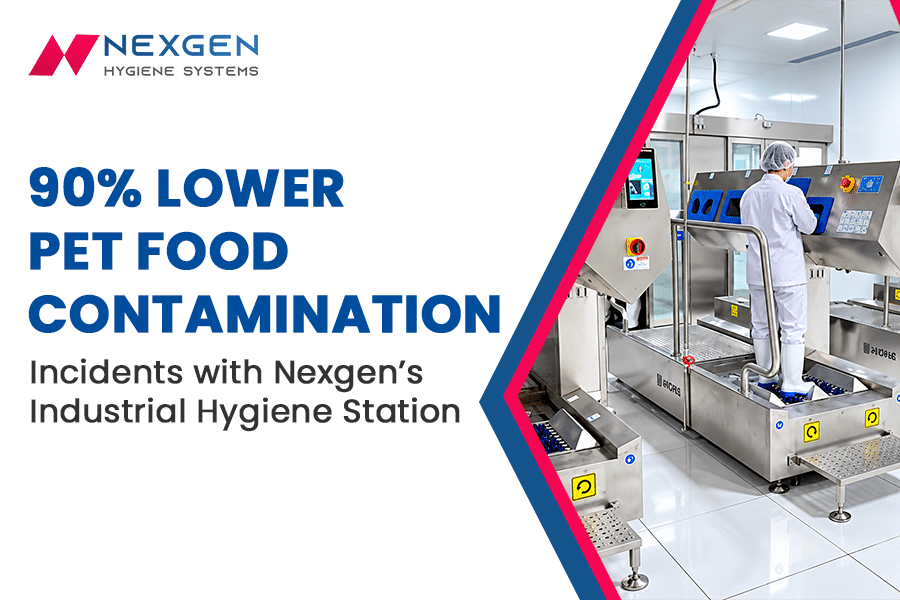
We installed Nexgen’s sensor-operated All-in-One Hygiene Stations at every zone transition point in the facility. Each unit combines touchless hand sanitization and automated gumboot or sole cleaning in a compact design. The entry system allows workers to move to the next zone only after completing the hygiene cycle, making hygiene an enforced step rather than a suggestion.
Sensor-Operated, Touchless Sanitization
A hands-free trigger delivers a consistent sanitizer dose on every pass, removing the touchpoint contamination risk of manual taps and valves.
Integrated Sole and Gumboot Cleaning
An automated brush-and-rinse cycle cleans footwear before zone entry, directly addressing the footwear-borne transfer identified during the facility’s root-cause investigation.
.
Access-Gated Entry Logic
Workers cannot enter the next zone until they finish the full hygiene sequence. This means compliance does not depend on individual discipline; it is now part of the plant’s layout.
Automated Hygiene Control Suited to Food Industry Wash-Down
Food-grade SS304 stainless-steel construction and an IP-rated, wash-down-friendly design meet FSSAI infrastructure expectations for facilities handling raw animal-based ingredients.
Low-Maintenance, Shift-Ready Throughput
The quick-cycle design prevents queues during shift changes, so the hygiene checkpoint does not slow production.
Implementation
Phase 1 – Zone Mapping & Risk Assessment
Nexgen’s team walked the full production flow, identified every zone-transition point carrying elevated cross-contamination risk, and prioritized installation using the facility’s existing microbial audit history.
Phase 2 – Installation & Calibration
We installed hygiene stations at each identified checkpoint. The team calibrated sanitizer dosage and sole-cleaning brush pressure to the facility’s footwear standards and floor type, then validated them with test runs at every entry point.
Phase 3 – Staff Training & Compliance Handover
Shift supervisors and floor staff were trained on the stations, and the QA team received a documented hygiene compliance SOP along with a maintenance and inspection schedule to support ongoing audit readiness.
Measurable results
90% Reduction in Contamination Incidents
Post-installation swab testing at zone boundaries showed a 90% drop in microbial contamination flags tied to personnel movement within the first full quarter of operation.
FSSAI Audit Readiness Significantly Improved
With hygiene infrastructure standardized and enforced at every zone entry, the QA team can now produce consistent compliance evidence during FSSAI inspections instead of relying on training records alone.
Zero Compliance-Related Production Stoppages
Production halts that had previously followed failed swab tests at zone boundaries dropped to zero after the hygiene stations went live.
Consistent Hygiene Compliance Across All Shifts
Because entry is gated by the hygiene cycle rather than left to individual discretion, compliance no longer varies between day shift, night shift, or supervisor.
Client perspective
“We had good people and reasonable hygiene rules, but rules only work if they’re followed every single time, on every shift. The Nexgen stations don’t give anyone a choice — you can’t get to the next zone without completing the cycle. That’s exactly the kind of control our auditors wanted to see.”
– Quality Assurance Manager, Pet Food Manufacturing Facility (anonymized)
Takeaway
For this facility, the main contamination risk was not raw materials or processing equipment. Instead, it was people moving between zones with different microbial risks. Sensor-gated hygiene stations solved this by making personnel hygiene monitoring automatic, not optional.
Contamination control in pet food manufacturing increasingly comes down to enforcement, not intention. A hygiene checkpoint that depends on individual discipline will eventually fail; one that’s built into the facility layout doesn’t.
Nexgen Hygiene Systems designs and installs sensor-operated hygiene stations for pet food, dairy, bakery, and other food manufacturing facilities across India, engineered around each plant’s zone layout and compliance requirements.
Contact Nexgen Hygiene Systems Contact Nexgen Hygiene Systems
Note: For confidentiality reasons, the client’s actual name has not been disclosed in this case study. The company is represented as a leading pet food manufacturing facility in India. All challenges, implementation details, and performance results are based on real deployment data and verified operational outcomes.
Note: For confidentiality reasons, the client’s actual name has not been disclosed in this case study. The company is represented as a premium packaged juice and beverage manufacturer based in Gujarat. All challenges, implementation details, and performance results are based on real deployment data and verified operational outcom