

Client
Premium FMCG Food Manufacturer

Industry
Packaged Snacks, Ready-to-Cook Mixes & Spice Processing

Challenge
Fragmented processing systems, inconsistent hygiene practices, and poor moisture control across three production lines created compliance risks, operational bottlenecks, and product rejection issues.
Overview
A mid-sized FMCG food manufacturer in Gujarat operated three separate production lines for snacks, ready-to-cook mixes, and packaged spices. Each line had its own equipment and hygiene routines, with no standard compliance process in place. The company contacted us to help them upgrade to automated, hygienic food processing systems.
We provided a complete smart food processing solution, including automated machinery, sensor-operated hygiene stations with HMI cycle control, and custom conveyor and drying systems for all three lines.
- Type: Multi-product FMCG food manufacturer
- Industry: Packaged snacks, ready-to-cook mixes, spices
- Challenge: Archaic hygiene practices and processing equipment across the three production lines led to compliance gaps, lower yields, and increased audit risk.
Key challenges
No Enforced Entry Hygiene Protocol
Each line followed its own informal hygiene routine. Workers sometimes skipped steps during shift changes, and there was no documentation available for FSSAI or retail buyer audits.
Fragmented Equipment and Mismatched Capacity
Each line was assembled over the years with machines from different suppliers, and no conveyor links between stages. Faster machines sat underutilized because upstream stages could not keep pace.
Moisture Control Issues
Inadequate drying between washing and packaging resulted in inconsistent moisture levels in the finished product, leading to shelf-life complaints and batch rejections from retail buyers.
No Compliance Records for Retail Buyers
Two major buyers set formal hygiene compliance requirements. Without a traceable hygiene record, the facility could not meet these standards and risked losing the contracts.
Solution: Integrated Turnkey Line with HMI-Controlled Hygiene Stations
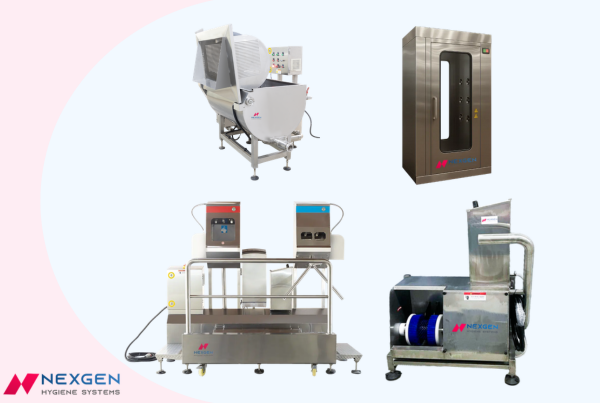
Nexgen Hygiene Systems provided a complete turnkey food processing solution for all three lines. We integrated HMI-controlled hygiene stations, automated food-processing machinery, custom conveyors, and drying systems into a single GMP-compliant setup, tailored to the client’s factory layout and product mix.
HMI-Controlled Hygiene Stations at Every Line Entry
We installed sensor-operated all-in-one hygiene stations at the entry to each of the three production lines. The Human-Machine Interface (HMI) enables setting and locking the cycle duration for each step. At the core of smart manufacturing in the food industry, this gave the facility a consistent, enforceable hygiene protocol across all three lines and all shifts for the first time.
Integrated Automated Processing Line per Product
Each line received advanced food-processing technology tailored to its specific product. The snacks line received an upgraded slicing machine with a centrifugal dryer. The ready-to-cook line received a vegetable dicing machine, tilting washer, and leafy vegetable cutter. The spice line received a chopping machine with an integrated tray dryer.
Custom Conveyor Integration
We designed and supplied conveyor systems for all three lines, connecting each processing stage and removing the need for manual transfers between stations. Each conveyor was matched to the throughput of the surrounding machines to keep the flow continuous and uninterrupted.
Air Knife and Tray Drying Systems
Air knife drying systems were integrated into the snacks and spice lines to remove surface moisture post-wash. A tray dryer was integrated into the ready-to-cook line for batch-drying cut vegetables before packaging.
Hygienic Layout
All three lines were built to hygienic food processing system standards, using SS 304/316 construction throughout. They feature open-frame designs, tool-free disassembly of food-contact parts, and sloped drain channels for easy cleaning.
Implementation
Phase 1 – Audit & Turnkey Line Design
We audited all three lines, mapping equipment, throughput rates, hygiene risks, and layout constraints. The client’s operations team reviewed and approved the full turnkey line design before procurement began.
Phase 2 – Line Integration & Commissioning
We upgraded each line one at a time over five weeks, while keeping the other two running. We configured and tested the HMI cycles for the hygiene station. Conveyor integration was completed, and drying systems were calibrated to match actual product moisture levels.
Phase 3 – Operator Training & Handover
We trained shift supervisors and machine operators on all the upgraded equipment and how to use the hygiene stations. At the end of the project, we provided an operations manual, an HMI configuration guide, a cleaning schedule, and a spare parts inventory.
Measurable results
Hygiene Compliance Standardized Across All Three Lines
HMI-enforced hygiene station cycles skipped steps at every entry point. For the first time, the facility had a consistent, documented hygiene protocol across all lines and all shifts, directly addressing the corrective actions raised by retail buyer audits.
Retail Buyer Audits Passed Without Hygiene Findings
Both retail buyer audits done after commissioning passed with no hygiene-related findings. HMI cycle logs served as documented proof of compliance, replacing the informal manual records that had not been enough before.
30–35% Improvement in Line Throughput
By integrating conveyors and matching machine capacities, we removed the bottlenecks between stations that had limited throughput on all three lines. Output per shift increased by 30–35% without adding more staff or extra shift hours.
Moisture-Related Batch Rejections Eliminated
The integrated drying systems on the snacks and spice lines kept finished product moisture levels within the required range. As a result, batch rejections from retail buyers due to moisture issues dropped to zero within the first two months.
Retail Contracts Secured
With documented hygiene compliance and improved throughput, the company met the formal requirements of both retail buyers by installing all-in-one hygiene stations at key transit points. One contract led to a 40% increase in monthly order volume.
Client perspective
“Our biggest problem was not that we had bad equipment — it was that we had no system. Three lines, three different ways of doing things, and nothing we could actually show an auditor. The hygiene stations alone changed how our team thinks about entry protocols. Now there is a process, it is enforced, and we have the records to prove it. That is what got us through the buyer audits.”
– Operations Head, Multi-Product FMCG Food Manufacturer, Gujarat (anonymized)
Takeaway
By replacing fragmented, manually managed equipment with an integrated Industry 4.0 food processing setup, this manufacturer standardized hygiene compliance across three lines, eliminated moisture-related rejections, and secured retail contracts that were previously out of reach.
Smart manufacturing in the food industry: For most food manufacturers, the most valuable upgrade is not a dashboard. Instead, it is building process control directly into the equipment with HMI-enforced hygiene cycles, matched-capacity line integration, and drying systems that work together as one system.
Nexgen Hygiene Systems designs and supplies complete turnkey lines that integrate hygiene stations, food processing machinery, conveyor systems, and drying solutions. Each system is custom-built around the client’s product mix, layout, and compliance needs.
Contact Nexgen Hygiene Systems to learn more.
Note: For confidentiality reasons, the client’s actual name has not been disclosed. A general description has been used to illustrate Nexgen’s integrated preprocessing line’s performance while maintaining client privacy.
Note:
To maintain client confidentiality, the actual name of the ready-to-eat fruit manufacturing company has not been disclosed in this case study. The company is represented as a premium frozen fruit processing and fresh-cut packaging facility based in India. All challenges, implementation details, and performance results are based on real deployment data and verified operational outcomes. This approach ensures privacy while accurately reflecting the real-world impact of the high-speed fruit dicing and slicing machine in high-volume food processing environments.