

Client
Premium Ready-to-Eat Food Manufacturer

Industry
Frozen Fruit Products & Fresh-Cut Packaging

Challenge
A processing bottleneck in the fruit preparation line limited production speed, reduced operational efficiency, and restricted the facility’s ability to increase daily output and product variety.
Overview
A mid-sized frozen vegetable manufacturer in Maharashtra processed about 8 tonnes of mixed vegetables per shift using five separate machines without any conveyor integration. They approached us seeking an integrated food-preprocessing solution, so we redesigned their vegetable processing line.
As their export volumes grew by 25–30% each year, the company needed a scalable, automated food processing system to handle the entire preprocessing sequence in one continuous, hygienic flow. We designed and delivered a turnkey vegetable processing line that meets GMP and export audit standards.
- Type: Ready-to-cook and frozen food manufacturer
- Industry: Frozen vegetables, RTC mixes
- Challenge: Manual and fragmented preprocessing led to bottlenecks, yield loss, and hygiene compliance issues during washing, peeling, cutting, and inspection.
Key challenges
Manual, Fragmented Preprocessing Flow
Moving tubs between stations took up almost 20% of each shift’s processing time. The faster cutting equipment was often idle because washing and peeling could not keep up.
Inconsistent Product Quality and Yield Loss
Manual peeling led to significant differences in yield between operators and shifts. Inconsistent sizes led to rework and complaints from export customers who expect uniform products.
Heavy Labour Dependency
The preprocessing area needed 28–32 workers per shift. If someone was absent at any station, production stopped right away. Complaints about manual handling were also rising.
Hygiene and Cross-Contamination Risks
Open transfer points, recessed joints, and equipment that was hard to clean were identified as contamination risks during an internal pre-audit review.
No Real-Time Process Visibility
Throughput reporting was done manually and only after the fact. The production team could not spot or fix bottlenecks during a shift.
Solution: Automated Food Processing System
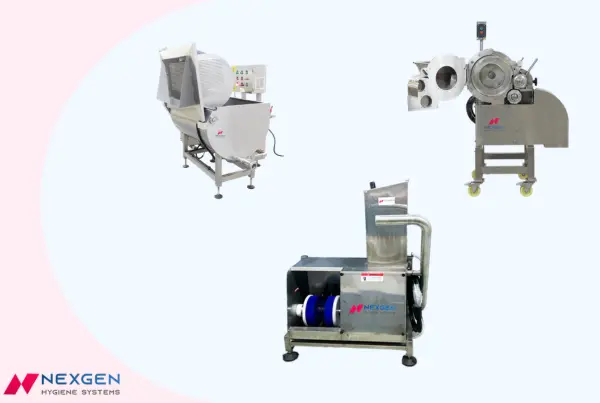
Nexgen Hygiene Systems provided a complete turnkey food processing solution, combining all preprocessing stages into one continuous, GMP-compliant flow. The line was custom-built for the client’s factory layout using only SS 304/316 stainless steel.
Core elements
Reception and Pre-Wash Conveyor
A perforated belt removes loose soil and debris before the product reaches the wash stage. This reduces contamination and helps filters last longer.
Fruit and Vegetable Washing
Leafy greens go through a bubble washer, while root vegetables use a drum washer. Closed-loop water filtration cuts water use by about 30–35% compared to open-wash methods.
Peeling Module
A continuous-feed peeling system has adjustable settings for different product sizes. An automated leafy greens trimming conveyor is placed in line.
Cutting and Dicing Equipment
A multi-function industrial food machine handles dicing, slicing, and shredding for all product types. It is directly connected to the peeling conveyor.
Inspection Conveyor
The inspection belt, placed after cutting, has adjustable speed and built-in lighting. The ergonomic lighting design helps reduce operator eye fatigue during long shifts.
Hygienic Layout
The line uses stainless-steel construction, open-frame designs, and easy access for cleaning all critical parts.
Implementation
Phase 1 – Audit & Line Design
We audited the site to map the current flow, floor space, utilities, and operator challenges. The client’s operations and maintenance teams reviewed and approved the detailed layout before procurement.
Phase 2 – Installation & Commissioning
We installed the new line in phases to avoid shutting down production. The wash and conveyor stages were installed during a planned maintenance weekend, while the cutting and peeling stations were added during a staggered shutdown.
Phase 3 – Operator Training & Handover
We provided two weeks of structured training for shift supervisors and machine operators, covering start-up, cleaning, and basic maintenance. At the end of the project, we handed over the operations manual, cleaning schedule, and spare parts inventory.
Measurable results
2–3× Preprocessing Throughput
With continuous-flow processing, the facility increased output from 8 tonnes per shift to about 22–24 tonnes per shift on mixed vegetables, all within the same space and shift hours.
30–40% Reduction in Labor Headcount
Preprocessing now runs with 18–20 workers per shift instead of 28–32. Labor cost per processed tonne dropped by about 32% in the first quarter.
Improved Cut Quality and Yield
Root vegetable yield improved by an average of 10–12%. Product write-offs and rework dropped by more than 60% in the first three months.
Zero Hygiene Non-Conformances at Post-Install Audit
A third-party hygiene audit six weeks after commissioning found zero non-conformances related to equipment or line hygiene. This was a first for the facility.
Indicative Payback: 18–24 Months
Savings from lower labour costs, better yield, and less rework are expected to pay back the full investment before the 30-month internal target.
Client perspective
“Earlier, our preprocessing section was our biggest unknown. Even when demand was there, we were unsure how much the line could really handle in a day. After the integrated line was installed, the flow became predictable, and hygiene improved. It is much easier now to plan production and commit to higher volumes.”
– Operations Head, Vegetable Processing Plant, India
Takeaway
By switching from a fragmented manual setup to an integrated food processing automation line, this manufacturer tripled preprocessing throughput, cut labor needs by 35%, and met audit-ready hygiene standards, all within the same factory space.
Food Processing Solutions India: Nexgen Hygiene Systems has deployed integrated preprocessing lines across India and internationally, customized to the client’s product mix, layout, and compliance requirements.
If you are considering an integrated preprocessing line for your food processing plant, a turnkey solution can help you boost capacity while maintaining high hygiene and consistency.
Note: For confidentiality reasons, the client’s actual name has not been disclosed. A general description has been used to illustrate Nexgen’s integrated preprocessing line’s performance while maintaining client privacy.
Note:
To maintain client confidentiality, the actual name of the ready-to-eat fruit manufacturing company has not been disclosed in this case study. The company is represented as a premium frozen fruit processing and fresh-cut packaging facility based in India. All challenges, implementation details, and performance results are based on real deployment data and verified operational outcomes. This approach ensures privacy while accurately reflecting the real-world impact of the high-speed fruit dicing and slicing machine in high-volume food processing environments.