

Client
Large-Scale Juice & RTD Beverage Manufacturer

Industry
Packaged Juice, RTD Beverages

Challenge
An internal energy audit found that the post-wash bottle-drying stage used more electricity than almost any other step on the bottling line, which was surprising given its simple function.
Overview
A large-scale beverage manufacturer runs multiple bottling lines producing packaged juices and ready-to-drink beverages across a range of SKUs. Facing rising utility costs, the company commissioned an internal energy audit across its production facility to identify where it could cut costs without affecting output or quality.
The audit’s biggest finding was almost by accident: the post-wash bottle-drying stage, which used old hot-air tunnel dryers, used more electricity per shift than any other step except refrigeration, even though it was a simple task.
Earlier attempts to save power by lowering the heater output caused uneven drying and slowed down the line, so any savings were quickly lost.
The company approached Nexgen for an industrial drying solution for beverage lines that could cut energy consumption without the trade-offs a hot-air system forced on them.
- Type: Multi-line packaged juice and RTD beverage bottling facility
- Industry: Packaged juice, ready-to-drink beverages
- Challenge: Disproportionately high energy consumption at the bottle-drying stage, with earlier cost-cutting attempts compromising drying quality and line speed.
Key challenges
High Energy Consumption From Legacy Hot-Air Drying Systems
Hot-air tunnel dryers needed continuous heating during long shifts, making the drying stage the biggest electricity user after refrigeration. The company did not expect such high costs from what seemed like a minor processing step.
No Central Visibility Into Hygiene Compliance
The head-office quality team had no way to confirm hygiene practices at individual sites without an in-person visit, so problems were usually caught only after a contamination incident, not before.
Drying Performance Trade-Offs When Attempting Energy Cuts
Earlier efforts to reduce heater output as a cost-saving measure caused inconsistent moisture removal, which in turn caused label adhesion issues downstream, so the team reversed every attempted energy cut within weeks.
Sustainability Reporting Pressure From Retail and Export Partners
Several of the company’s retail and export partners had begun asking for energy-efficiency data as part of their own ESG reporting, and the drying stage (now clearly identified as an outlier) was the obvious place to show measurable improvement.
Solution: Nexgen Air Knife Drying System Replacing Hot-Air Tunnels Across Bottling Lines
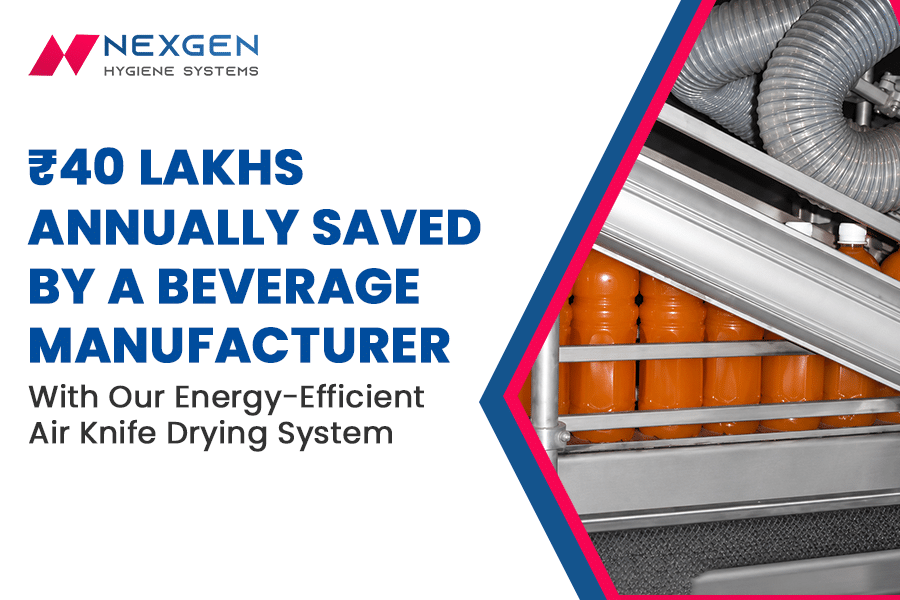
We replaced the hot-air tunnel dryers on the company’s bottling lines with Nexgen air knife drying systems. These use high-velocity, low-pressure air designed for the facility’s specific bottle shapes and line speeds, rather than constant heat.
Mechanical Air Displacement Instead of Sustained Heating
The air knife system removes moisture with high-velocity airflow instead of heat. This removes the need for continuous heating, which was the main reason the old dryer used so much power.
Compressed-Air Efficient Nozzle Design
The specially designed nozzles provide full drying coverage at lower air pressure and volume than a standard setup, which reduces the load on the plant’s compressed-air system.
.
Standardized Rollout Across Multiple Bottling Lines
The same air knife system was used on every converted line. This made it easier to manage spare parts, maintenance, and operator training compared to using different drying technologies.
No Trade-Off Between Energy Use and Drying Consistency
Unlike earlier attempts to save power with the hot-air system, the air knife’s mechanical approach removes moisture fully and consistently while using less energy. This solves the problem that made previous cost-cutting efforts fail.
Food-Grade, Low-Maintenance Stainless-Steel Build
Tool-free access to internal air channels and a hygiene-compliant stainless-steel construction keep the system easy to clean and maintain across continuous multi-shift operation.
Implementation
Implementation
Phase 1 – Energy & Line Audit
Nexgen’s team reviewed the facility’s existing hot-air tunnel consumption data line by line, mapped bottle formats and line speeds across each production line, and modeled expected energy consumption after conversion to air knife drying.
Phase 2 – Phased Line Conversion
The team converted lines one at a time during planned stoppages to avoid disrupting ongoing production, calibrating nozzle pressure and angle to each line’s specific bottle formats.
Phase 3 – Performance Validation & Energy Monitoring Handover
The team ran parallel energy monitoring before and after conversion on each line, then handed the plant’s engineering team documented consumption benchmarks and a maintenance schedule to sustain the gains long-term.
Measurable results
₹40 Lakhs in Annual Energy Cost Savings
Across all converted bottling lines, the switch from hot-air tunnels to air knife drying delivered combined annual energy savings of approximately ₹40 lakhs.
Drying-Stage Energy Consumption Cut by Over 60%
Replacing sustained heating with high-velocity mechanical airflow cut electricity consumption at the drying stage by more than 60% per line.
No Loss in Line Speed or Drying Consistency
Unlike the company’s earlier cost-cutting attempts, the air knife conversion kept drying quality and line speed steady. This was the result that every previous effort had missed.
Faster, Cleaner Sustainability Reporting
With verified per-line energy benchmarks now in hand, the company’s sustainability team can report a concrete efficiency improvement to retail and export partners requesting ESG data.
Client perspective
“We’d tried to cut power at the dryer before, and it always cost us more in rejected bottles than we saved on the electricity bill. The air knife system is the first fix that actually gave us both — lower energy use and better, more consistent drying. The ₹40 lakh number got everyone’s attention, but the real win is that we’re not trading off quality to get it.”
– Plant Engineering Head, Juice & RTD Beverage Manufacturer (anonymized)
Takeaway
Energy cost reduction in juice manufacturing doesn’t have to mean rationing power at the cost of product quality. This beverage manufacturer’s real problem wasn’t that its dryer used electricity; it was that it used the wrong drying method for the job.
Air knife systems remove moisture mechanically instead of thermally, which is why they can cut energy use significantly without the trade-offs of simply turning down a heater.
For bottling lines looking at industrial drying solutions for beverage production, the lesson is clear: choosing the right drying technology for the actual moisture-removal task delivers both cost savings and consistency, instead of forcing a trade-off.
Nexgen Hygiene Systems designs and supplies custom air knife drying systems for juice, beverage, and packaged food lines across India, engineered around each client’s bottle geometry, line speed, and energy-efficiency goals.
Contact Nexgen Hygiene Systems Contact Nexgen Hygiene Systems
Note: For confidentiality reasons, the client’s actual name has not been disclosed in this case study. The company is represented as a large-scale packaged juice and RTD beverage manufacturer in India. All challenges, implementation details, and performance results are based on real deployment data and verified operational outcomes.
Note: For confidentiality reasons, the client’s actual name has not been disclosed in this case study. The company is represented as a multi-location bakery manufacturing chain in India. All challenges, implementation details, and performance results are based on real deployment data and verified operational outcomes.