
Hygiene misses can break customer trust, cost brand reputation, and incur fines and product recalls. A hand wash station is one of the most critical assets for hygiene controls in food manufacturing. It acts as a barrier, a contamination control equipment that protects the product from both pathogens and unwanted (and unintentional) material contamination.
Human contact is unavoidable in a production line, but with proper hygiene practices, it can be made harmless and contamination risk free. A food industry hand wash station, placed either at the plant entrance or before the production line, acts as the frontline security against contamination.
And manual hand hygiene, although enough if done with the right technique, may not be the most effective method. Manual hand hygiene systems depend entirely on people making correct decisions every single time, even when tired, rushed, or distracted. That dependency creates risk.
On top of that, food safety inspections and enforcement are tightening (as they should). Ditching the old sinks and soaps, plants are nowadays going for touchless (and sometimes, sensor-operated) hand-washing unit inclusive hygiene stations for factories.
There are other ways (than sensors) to make a handwashing station touchless. In this guide, we will explore the types, the applications, and what returns do food plant owners get from investing in handwash stations for hygiene.
What Makes a Hand Wash Station Different from a Regular Sink?
Walk into any office building, and you’ll find sinks. They work fine for casual handwashing. But put one of those sinks in a high-risk production zone, and you’ll quickly understand why food plants need something else.
Industrial hand wash stations are designed to run all day, every day, in active production environments. They’re built from food-grade stainless steel, with smooth surfaces and no hidden crevices where bacteria can settle.
Hand washing systems that are made for industries manufacturing consumable products, the water flow has to be consistent and of controlled quality. The system delivers a steady water flow and dispenses soap without hand contact. Cleaning staff wash and sanitize the station along with the rest of the production floor.
The real difference lies in how these stations shape behavior. The plant administrators integrate them into the workflow so that the employees cannot miss hand hygiene protocols.
In short, hand wash stations enforce compliance instead of relying on reminders or assumptions (like in the case of sinks and soaps).
How Hand Wash Stations Function in Food Manufacturing Operations
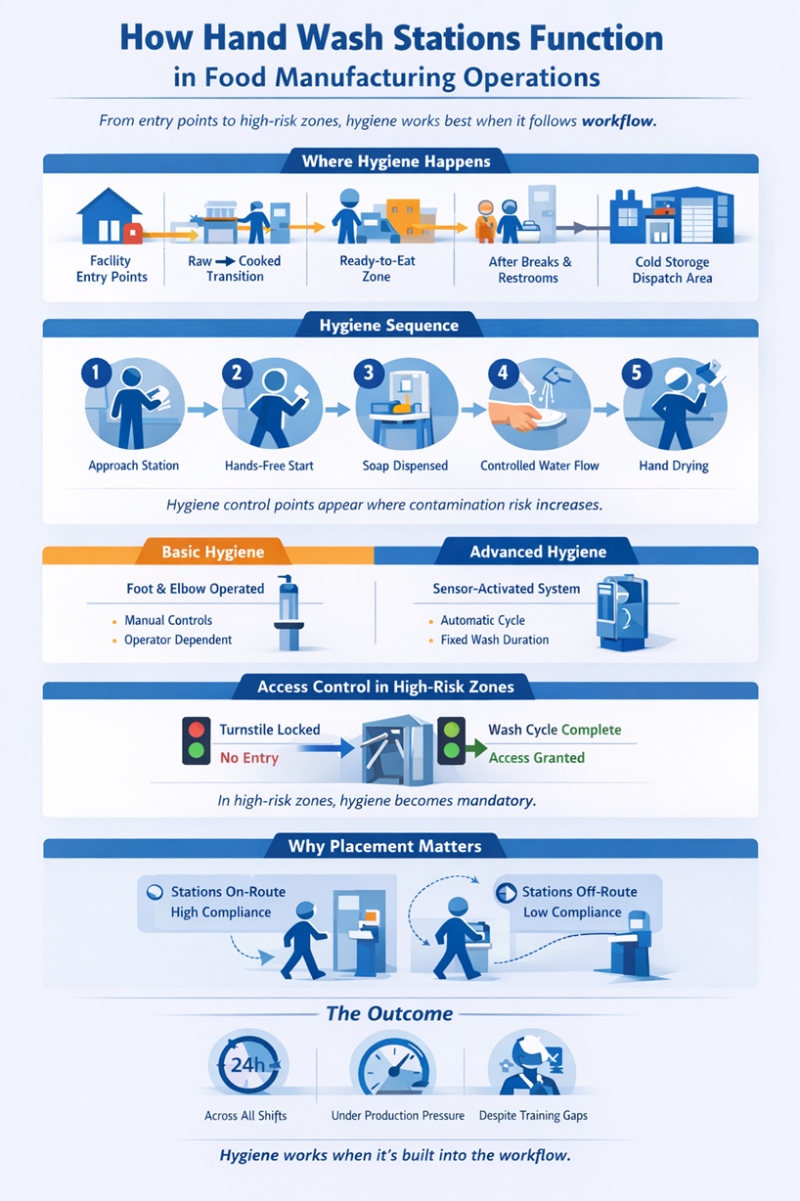
In food facilities, hygiene happens at specific control points where contamination risk increases. These points include moving from raw to cooked areas, entering ready-to-eat zones, returning from breaks, or coming back after a restroom visit.
At each of these transitions, workers pass through a hygiene station that leads them through the hand-washing sequence. In simpler setups, foot-operated taps and elbow dispensers keep hands away from contaminated surfaces. In more advanced setups, the station blocks forward movement until the full wash cycle finishes.
Some facilities integrate hand-wash stations with turnstile access control systems. The gate stays locked until the wash cycle ends. This setup strengthens system reliability. It keeps hygiene consistent even when workers feel rushed, tired, or undertrained.
Placement determines compliance. Stations placed directly in the workflow see the highest use. When workers detour to wash their hands, compliance drops. When stations sit exactly where hygiene decisions happen, the system performs as intended.
Essential Components of Industrial Hand Wash Stations
An effective industrial hand wash station includes far more than a wash basin. Designers build it as a complete hygiene system, with each component chosen to handle the realities of food production.
- Hands-free operation systems use foot pedals, knee actuators, or infrared sensors to control water flow. These mechanisms keep workers from touching faucet handles and recontaminating clean hands.
- Food-grade stainless steel construction relies on 304 or 316 stainless steel with smooth, welded seams. These surfaces resist corrosion and allow thorough cleaning, even under repeated exposure to caustic sanitation chemicals.
- Potable water delivery supplies clean, drinkable water at flow rates high enough for effective washing, typically between 1.5 and 2.5 gallons per minute. Some applications also require heated water to meet food service regulations.
- Calibrated soap dispensers release measured amounts of soap to ensure full hand coverage without excess waste. Touchless dispensing further reduces the risk of cross-contamination.
- Greywater collection systems capture used water in tanks sized to match or exceed the freshwater capacity. Facilities connect these systems to sanitary sewer lines to ensure compliant wastewater disposal.
- Hand drying systems use single-use paper towels or high-efficiency air dryers to complete the hygiene cycle. Designers place dispensers to avoid splash-back and secondary contamination.
- Vandal-resistant hardware uses industrial-grade components that withstand heavy daily use, frequent cleaning, and the wear associated with multi-shift operations.
Types of Hand Wash Stations Used in Food Manufacturing
Food manufacturing facilities manage different contamination risks based on product type, processing method, and production volume. A beverage bottling line faces different hygiene challenges than a raw meat or dairy operation. For this reason, hand wash station manufacturers design multiple station types to match specific operational needs.
Manual Hand Wash Stations with Hands-Free Operation
Many facilities begin structured hygiene programs with manual hand-wash stations. These units use foot pedal operation or knee-activated controls to operate water flow, which keeps workers from touching contaminated faucet surfaces. Soap dispensers typically use elbow activation, and some designs include integrated paper towel dispensers within the same stainless steel housing.
Manual hand wash stations work well in lower-risk zones or facilities with strong supervision. They require modest upfront investment, install easily, and need minimal maintenance. Their performance, however, still depends on whether each operator completes every step of the wash cycle correctly.
Sensor-Operated Automated Hand Wash Stations
Touchless hand wash stations remove variability from the hygiene process. Infrared or proximity sensors detect hands and trigger water flow and soap dispensing automatically. Facilities set wash cycle durations based on SOPs, and some models include automatic hand drying.
These systems deliver consistency. Every wash follows the same sequence, regardless of operator, shift timing, or production pressure. Auditors view this as a measurable process control rather than reliance on training alone.
Nexgen’s Sensor Operated All-in-One Hygiene Station combines hand washing, soap dispensing, and drying in a compact footprint. Facilities with limited floor space often choose this design when hygiene requirements remain strict. Touchless operation reduces cross-contamination while supporting fast throughput during shift changes.
Modular Hygiene Stations with Integrated Turnstile Access Control
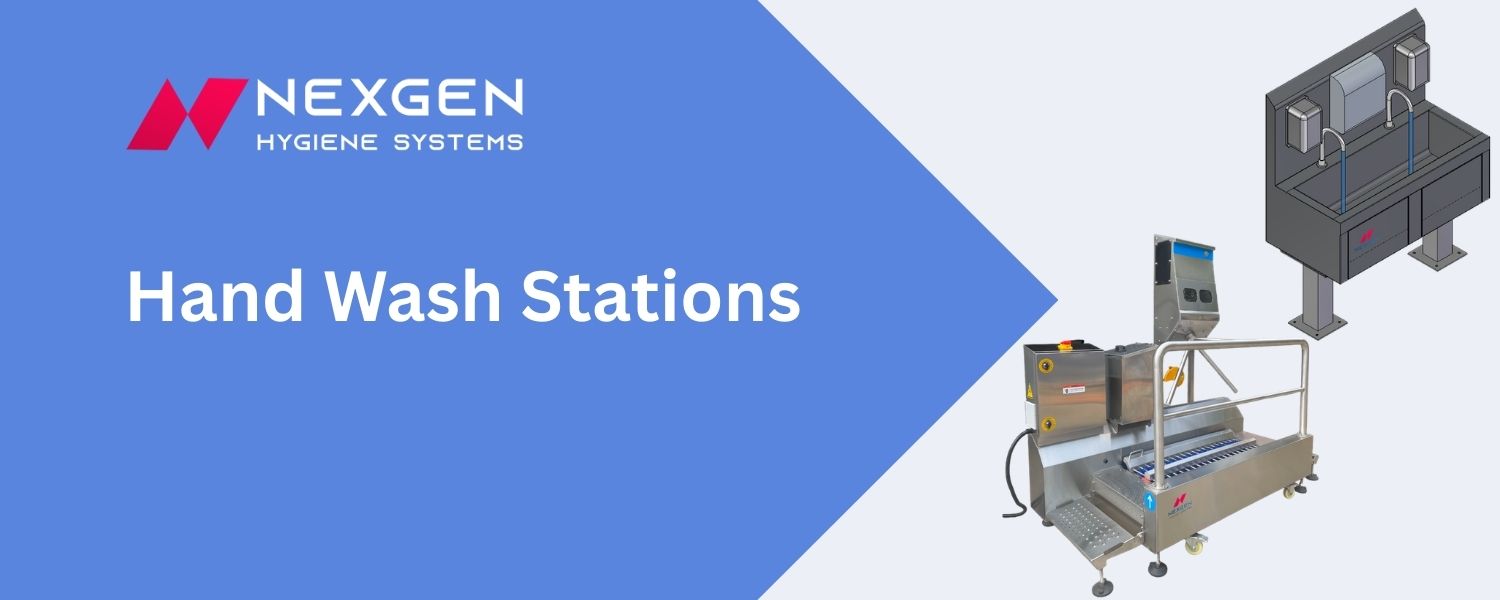
Facilities operating high-risk processing zones often deploy integrated hygiene stations that combine multiple sanitation steps into a single sequence. These systems typically include hand washing, hand sanitizing, and sole cleaning.
A motor-driven turnstile with traffic-light indicators defines the system. Red blocks access. Green signals hygiene completion and permits entry. Workers exit freely, but entry requires full hygiene compliance.
Nexgen’s modular hygiene stations follow forced-guidance principles. The system requires operators to complete hand washing and foot sole disinfection in the correct order. If someone attempts to skip a step, the station physically prevents entry.
This design suits facilities pursuing BRC AA+, SQF Level 3, or FSMA preventive controls compliance, where inspectors expect structural enforcement alongside cleanliness outcomes. Properly configured systems handle 15 to 20 people per minute, even during large shift changes.
Compact Hygiene Stations for Space-Constrained Transition Points
Some entry points lack space for full turnstile installations. Narrow corridors, compact cleanroom transitions, and dense production zones often require a smaller solution.
The Ecoline Hygiene Station from Nexgen addresses these constraints. It delivers hand washing, drying, hand disinfection, and sole cleaning without turnstile infrastructure. The compact design fits tight spaces while maintaining sensor-activated operation to reduce cross-contamination.
These stations typically process 10 to 15 users per minute. Facilities use them at secondary entry points, packaging zone transitions, and cold storage interfaces where larger systems prove impractical.
Knee-Operated and Foot-Operated Manual Stations
Facilities that want hands-free operation without full automation often select knee-pressure handwashing stations and foot-operated faucet systems. These designs eliminate direct hand contact with controls, require no electrical infrastructure, and keep costs manageable.
Common applications include pre-processing areas, packaging zones, and maintenance workshops where hygiene matters but contamination risk remains lower than in primary processing.
Gumboot Cleaning Stations with Integrated Hand Hygiene
In many food plants, footwear introduces as much contamination risk as hands. Workers move between zones and track bacteria across the facility on boot soles.
Gumboot cleaning machines with integrated hand hygiene address both risks at once. Rotating brush systems remove debris and sanitize soles while workers wash their hands in the same station. This setup suits operations where staff wear heavy industrial boots throughout their shifts.
Meat processing plants, dairy facilities, and operations with frequent movement between wet and dry zones commonly use this configuration.
Hand Wash Stations vs. Hand Sanitizer Stations
Food manufacturing facilities often ask whether hand sanitizer stations can replace traditional handwashing equipment. The answer is no. While both serve hygiene purposes, they address different contamination scenarios.
Air Knife Drying vs Traditional Drying Methods
| Feature | Hand Wash Stations | Hand Sanitizer Stations |
|---|---|---|
| Cleaning Method | Physical removal using water and soap | Chemical reduction of microorganisms |
| Effectiveness on Visible Soil | Highly effective on dirt, grease, and debris | Ineffective on visibly dirty hands |
| Allergen Removal | Removes allergenic proteins | Does NOT remove allergens |
| Regulatory Compliance | Required by the FDA, OSHA, and health departments | Supplemental only; cannot replace handwashing |
| Best Use | After the restroom, before food contact, zone transitions | Between tasks, when hands are already clean |
Hand-wash stations for the food industry physically remove contamination, while hand sanitizers chemically reduce microorganisms on already-clean hands. Food safety programs require both, positioned strategically based on contamination risk.
Strategic Placement of Hand Wash Stations for Maximum Contamination Control
Placement determines whether a hygiene station actually prevents contamination or simply satisfies paperwork. The critical question is not “where can a sink be installed?” but rather “where do contamination decisions occur in the production workflow?”
Entry Points into Processing Zones
Every time someone enters a production area from outside, contamination risk increases. Hand wash stations at main entry points intercept this risk before it becomes a problem. This placement is especially critical at shift starts, after breaks, and following restroom visits.
Transitions Between Raw and Cooked Product Zones
Cross-contamination between raw and ready-to-eat (RTE) areas remains one of the most scrutinized points during food safety audits. A hygiene station, designed for factories, installed directly at the boundary of the two regions, will ensure that the workers cannot enter the RTE zone until they complete the full hand wash cycle.
High-Risk Operations Like Ready-to-Eat Handling
RTE products receive no further kill step, making them particularly vulnerable to contamination. Hand hygiene stations in these areas require especially rigorous protocols. This is where automated systems and turnstile controls provide the most value.
Cold Storage and Dispatch Areas
Cold storage and dispatch zones create unique hygiene challenges. Workers move in and out frequently, often under time pressure. Stations placed near cold room entrances allow proper hand hygiene without creating delays or forcing employees to wait in refrigerated environments.
Packaging Lines
Packaging acts as the final control point before products leave the facility. Workers handle packaging materials, sealing equipment, and sometimes the product itself. Hand-wash stations positioned near packaging lines reduce the risk of last-minute contamination reaching customers.
Near Restroom Facilities
Facilities with multiple buildings or outdoor operations often install hygiene stations near restroom areas. This placement maintains hygiene control in zones without permanent plumbing and supports compliance where employee movement patterns require additional checkpoints.
Benefits of Proper Hand Wash Stations in Food Manufacturing
Contamination Reduction
The most direct benefit is contamination control. Proper hand hygiene reduces the transfer of pathogens, allergens, and foreign material into food products. When workers wash their hands correctly, effective handwashing removes more than 99% of transient bacteria.
Improved Audit Performance
Auditors now focus on how hygiene works in practice, not just what procedures say on paper. Food plants that enforce hygiene through physical systems perform better during inspections than those that rely only on training records.
Facilities using automated hygiene stations or turnstile controlled systems show clear evidence of control. The system requires compliance. This approach prevents non-conformances before auditors document them.
Operational Consistency
Production pressure exposes weak hygiene systems. When teams run short or fall behind schedule, manual hygiene steps often suffer first. Industrial hand wash stations designed to enforce compliance remove this risk. Hygiene continues even when production intensity increases.
Employee Accountability
When hygiene becomes part of the workflow, it stops feeling optional. Workers understand that they must complete the wash cycle before moving forward. Over time, this builds a culture where proper hygiene feels normal, expected, and routine.
Reduced Risk of Product Recalls
A single contamination incident can trigger recalls, production shutdowns, damaged customer relationships, regulatory scrutiny, and legal exposure. Hand hygiene equipment provides low-cost protection against high-impact failures.
In most cases, the cost of proper hygiene equipment remains far lower than the cost of one serious recall.
Meeting Health Department and OSHA Requirements
OSHA requirements mandate specific handwashing provisions on construction sites and food processing facilities. Health department regulations similarly require adequate handwashing facilities for food service operations. Systems that enforce hygiene reduce the need for constant supervision while maintaining compliance.
ROI: A Cost-Benefit Analysis
The cost of a hygiene station depends on its configuration. A basic manual unit may cost a few thousand dollars. A fully automated, multi-bay system with turnstile control can reach into the tens of thousands.
To assess ROI accurately, food plants need to look well beyond the purchase price.
Direct Cost Savings
Proper hygiene systems reduce rejected batches, limit rework, and cut corrective action expenses. Automated stations also control water, soap, and chemical usage more precisely than manual washing, which often leads to overuse. In multi-shift operations, these savings add up quickly.
Indirect Cost Savings
Well-designed hygiene stations reduce the time teams spend preparing for audits and managing observations. Automated systems also improve production flow by completing wash cycles in 12 to 15 seconds, compared to 20 seconds or more with manual washing.
Consistent hygiene performance builds buyer confidence, which supports contract renewals and long-term customer relationships.
Risk Mitigation Value
A single hygiene related recall can cost far more than equipping an entire facility with advanced hygiene stations. Food safety teams treat contamination control equipment as risk management, not discretionary spending.
Plants that invest in hygiene infrastructure often recover their investment within 18 to 36 months, even without accounting for avoided recalls or audit failures.
Regulatory Compliance: OSHA, FDA, and Food Safety Standards
A clear understanding of regulatory requirements helps facilities choose the right equipment and place it where it actually supports compliance.
OSHA Construction and Food Processing Requirements
OSHA requires employers to provide adequate and accessible handwashing facilities on construction sites and in food processing operations. While the exact ratios vary by application, construction sites typically require one handwashing station for every 20 employees.
OSHA focuses less on fixed numbers and more on accessibility. Facilities must ensure workers can wash their hands when needed. When operations fail to meet this expectation, OSHA can issue citations, impose fines, or halt work until conditions improve.
FDA Food Code Standards
The FDA Food Code defines handwashing requirements for food service and food manufacturing environments. These standards influence how facilities design and place hand-wash stations.
Key FDA expectations include:
- Facilities must keep handwashing sinks separate from food preparation and warewashing sinks
- Water temperature must reach at least 100°F (38°C), with many operations targeting 105°F for effective cleaning
- Facilities must supply soap and either single-use towels or air dryers.
- Facilities must post signage reminding employees to wash their hands.
Meeting these requirements consistently often requires more than basic sinks, especially in high-throughput environments.
GFSI Certification Requirements (BRC, SQF, FSSC 22000)
GFSI-benchmarked standards such as BRC, SQF, and FSSC 22000 place strong emphasis on demonstrable hygiene control. Auditors look beyond the presence of equipment and assess how facilities enforce hygiene.
During audits, inspectors evaluate whether facilities:
- Provide handwashing stations at appropriate control points
- Use systems that ensure hygiene compliance, not just availability.
- Monitor and verify hygiene practices.
- Maintain records that show consistent use
Facilities targeting AA+ ratings or higher certification levels typically rely on automated or enforced hygiene systems rather than manual stations alone.
Local Health Department Requirements
In addition to federal standards, local health departments often apply their own rules. These may affect water temperature requirements, sink design, or station placement. Reviewing local regulations before purchasing equipment helps facilities avoid costly retrofits and compliance gaps.
How to Choose the Right Hand Wash Station Manufacturer
Not all hand wash station manufacturers design for food production. Equipment built for general industry often fails under daily washdowns or does not fit real plant workflows.
Focus on these essentials:
Food Industry Experience
Choose manufacturers with proven experience in food processing. They understand hygiene zoning, aggressive cleaning regimes, and compliance requirements under USDA, FDA, and GFSI standards.
Build Quality
Look beyond “stainless steel.” Specify 304 or 316 grade stainless steel with smooth, welded seams. Stations face frequent chemical cleaning, and poor materials fail quickly.
Customization Capability
Every facility differs. Manufacturers should adapt station layouts, wash cycles, and integration features to match your plant design and SOPs.
Service and Support
Hygiene equipment must run reliably. Strong technical support, fast spare parts access, and clear service escalation matter more than upfront cost in 24/7 operations.
Proven Track Record
Ask for references from similar facilities. Real-world feedback reveals installation quality, reliability, and long-term support performance.
Nexgen Hygiene Systems brings over 20 years of experience across food, beverage, and pharmaceutical facilities, with 5,000+ installations worldwide and ongoing technical support across global markets.
Building Hygiene Infrastructure for Modern Food Manufacturing
A hand wash station is foundational infrastructure in modern food manufacturing. When selected correctly, placed at the right control points, and integrated into industrial sanitation systems, it functions as essential contamination control equipment that protects products, supports audits, and reduces operational risk.
The food industry continues to move toward structural hygiene enforcement. Facilities that rely only on training and supervision struggle to maintain consistency across shifts and production pressure. Facilities that embed hygiene into physical systems achieve better audit outcomes, fewer contamination incidents, and more stable operations.
Whether a plant requires a compact Ecoline Hygiene Station for a tight entry point, a sensor-operated hand wash station for high-throughput areas, or modular hygiene stations for factories with turnstile control, the right equipment already exists. The real decision lies in matching hygiene infrastructure to actual risk.
Nexgen Hygiene Systems designs and manufactures food industry hand wash station solutions for food processing, beverage, and pharmaceutical facilities. From basic hands-free stations to fully integrated systems with access control, the equipment supports real production conditions and audit expectations.
For facilities evaluating upgrades or redesigns, a conversation with Nexgen’s hygiene team can help clarify which hand wash station configurations best fit real production risks.
FAQs
How many handwashing stations does a food manufacturing facility need?
Requirements vary based on facility size, employee count, and production zones. OSHA requires one station per 20 employees as a baseline. Food safety best practices suggest stations at every zone transition, every entry point, and near every high-risk operation.
Facilities should calculate needs based on peak employee count and production flow rather than minimum regulatory requirements.
What's the difference between a hand wash station and a hand sanitizer station?
Hand-wash stations use water and soap to physically remove contamination from hands. Hand sanitizer stations use alcohol-based gel to kill microorganisms on hands.
Hand sanitizers are less effective on visibly dirty hands and don’t remove physical contamination. They work well as supplementary hygiene between washes, but rarely substitute for proper handwashing in food manufacturing applications.
Can facilities build custom hand-wash stations instead of purchasing commercial units?
Custom-built stations may work for single-site permanent installations, but rarely meet the durability, compliance, and consistency requirements of professional industrial hand wash stations.
Commercial units are engineered for repeated washdowns, incorporate food-grade materials, and include features like metered dispensing and greywater management that DIY solutions typically lack.
What water temperature is required for food manufacturing hand-wash stations?
General production areas can use ambient temperature water. Food service and food preparation areas typically require 100°F to 105°F (38°C to 40°C) water temperature per the FDA Food Code and local health department regulations.
Facilities should verify local requirements, as some jurisdictions mandate specific temperature ranges.
How often do hand-wash stations require maintenance?
Maintenance frequency depends on usage intensity. High-traffic stations may need daily checks of soap and towel levels. Weekly sensor calibration checks prevent operational failures. Monthly deep cleaning maintains hygiene standards.
Automated systems typically log usage data, enabling predictive maintenance scheduling based on actual wash counts rather than arbitrary time intervals.