

Client
Premium Packaged Juice & Beverage Manufacturer

Industry
Packaged Juice, RTD Beverages, Bottled Drinks

Challenge
Residual moisture that remained on washed bottles led the quality control team to reject labels and experience inconsistent drying across bottle sizes, which slowed the line and increased rejection rates.
Overview
A mid-sized juice and beverage brand in Gujarat runs a high-speed bottling line that produces multiple SKUs, ranging from 200ml single-serve juice bottles to 1-litre RTD beverage packs.
After washing, the line operators used an old hot-air tunnel dryer that left inconsistent moisture on bottle surfaces, especially around the base and shoulder. The labels failed to adhere properly before packaging, and the slow drying process became the bottleneck for the line.
The company approached us for a bottle drying machine that could keep pace with their fill-and-label speed without the label adhesion problems they faced.
We replaced the existing hot-air tunnel with a Nexgen air knife drying system, engineered specifically for the beverage plant’s bottle geometry and line speed.
- Type: Multi-SKU juice and RTD beverage bottling plant
- Industry: Packaged juice, ready-to-drink beverages
- Challenge: Moisture retention after washing led to label rejection, slow drying cycles, and rising energy costs due to an outdated hot-air system.
Key challenges
Label Adhesion Problems Caused by Residual Bottle Moisture
Even a thin film of moisture left on the bottle surface after washing weakened the label glue bond. Labels would peel, bubble, or shift during transit, and the QC team caught an increasing share of these defects at the end of the line, after the bottle was filled and capped.
No Reliable Way to Prevent Label Rejection Across Bottle Shapes
The line ran three different bottle shapes across its SKUs. The old dryer treated every bottle the same, so it failed to dry contoured areas like the base ring and shoulder curve evenly. This inconsistency made it difficult for engineers to standardize a fix because what worked for one shape often failed on another.
High Energy Cost and Slow Cycle Time From the hot-Air Tunnel Dryer
The hot-air tunnel required nearly twice as much time per batch as the rest of the line could handle and consumed significant power to maintain temperature. The drying process bottlenecked the line, and utility costs per shift kept climbing.
Solution: Custom Air Knife Drying System for Beverage Bottling
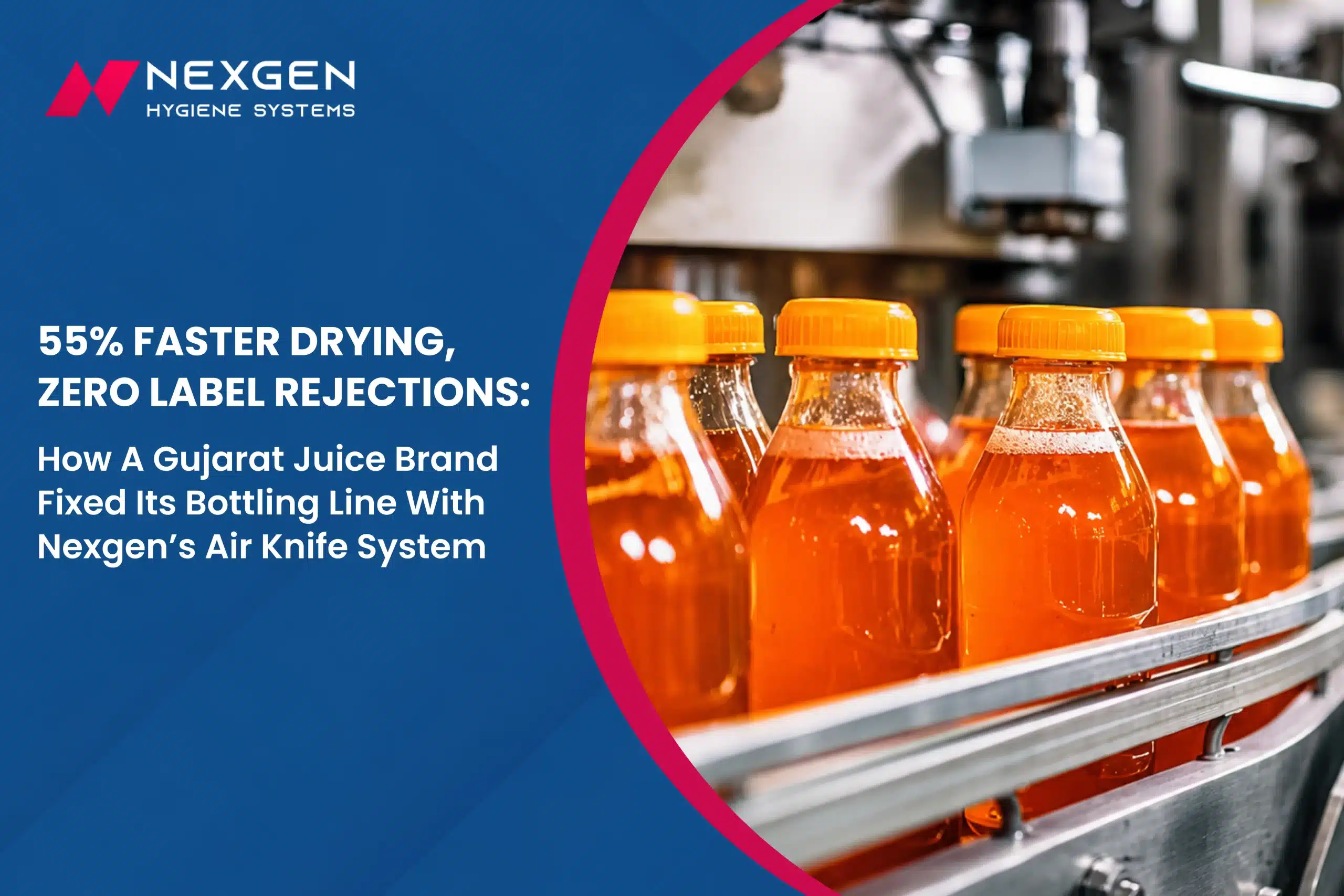
We designed and installed a Nexgen air knife drying system, purpose-built for this beverage plant’s bottle-washing-to-labelling sequence. The system replaces heat-based drying with high-velocity, low-pressure air, engineered around the exact bottle profiles running on the line.
Air Knife System Installed Directly After the washing STage
We placed the air knife unit immediately after the bottle washer, so bottles passed through a focused air stream before reaching the labelling station. This change eliminated the drying delay between wash and label.
Adjustable Nozzle Configuration for Multiple Bottle Formats
Because the line runs three bottle shapes, we configured multi-angle, adjustable nozzles that direct airflow across the base, body, and shoulder, the exact zones where moisture was trapped. Operators can reposition nozzles quickly during SKU changeovers.
.
Air Knife vs Hot-Air Dryer : Lower Energy Use , Faster Cycle
Unlike the hot-air tunnel, the air knife system uses ambient or lightly conditioned air at high velocity rather than sustained heating, thereby cutting cycle time and power draw. Mechanical force replaces heat, so drying happens faster and costs less to run.
HACCP-Hygiene SS Construction Aligned with FSSAI Requirements
The system is built in stainless steel with an open-frame design and tool-free access to internal air channels, supporting the hygiene documentation the plant needs for FSSAI audits.
Implementation
Phase 1 – Line Audit & Bottle Profile Mapping
We studied all three bottle shapes, line speed, washer output, and labelling timing to size the air knife unit and plan nozzle placement.
Phase 2 – Installation & Nozzle Calibration
We installed the air knife system in the wash-to-label gap during a planned stoppage. Our team calibrated the nozzle angle and airflow pressure for each bottle format and tested moisture levels at the base, body, and shoulder after each run.
Phase 3 – Operator Training & Handover
We trained line operators on nozzle repositioning for SKU changeovers and basic maintenance. We handed over an operations manual, a nozzle-configuration guide for each bottle format, and a maintenance schedule.
Measurable results
Drying Time Cut by 55%
Replacing the hot-air tunnel with the air knife system cut the drying cycle by 55%, removing the bottleneck that was slowing the entire bottling line.
Label Rejection Eliminated
With consistent, zone-specific drying across all three bottle shapes, label adhesion failures dropped to zero within the first month, resolving the label adhesion problem that had been driving QC rejections.
Energy Costs Down on the Drying Stage
Switching from sustained hot-air heating to high-velocity air knife drying reduced power consumption, lowering the plant’s per-shift utility cost for this stage.
FSSAI Audit Documentation Now in Place
The stainless-steel, tool-free-access build enabled the plant to present hygiene documentation directly during FSSAI beverage-bottling hygiene equipment reviews.
Line Throughput Increased Without Added Staff
With drying no longer the slowest step, the bottling line’s overall output per shift increased without any additional labour or equipment elsewhere on the line.
Client perspective
“Every rejected bottle at the labelling stage was money and time we couldn’t get back. We needed the right kind of drying for the bottles we actually run. The air knife system solved that in weeks, not months.”
– Plant Operations Manager, Packaged Juice & Beverage Manufacturer, Gujarat (anonymized)
Takeaway
By replacing a slow, energy-intensive hot-air tunnel with a purpose-built air knife drying system, this Gujarat juice brand eliminated label rejections, cut drying time by more than half, and freed up throughput across its entire bottling line.
Air knife vs hot-air drying for beverage plants: For most bottling lines, the real fix for label adhesion issues isn’t a stronger label glue or a longer dry cycle. It’s matching the drying method to the bottle’s actual moisture zones.
Air knife systems do this with mechanical airflow rather than heat, which is why they dry faster, cost less to run, and hold up better under FSSAI hygiene scrutiny.
Nexgen Hygiene Systems designs and supplies custom air knife drying systems for juice, beverage, and packaged food lines across India. Each system is built around the client’s bottle geometry, line speed, and compliance needs.
Contact Nexgen Hygiene Systems Contact Nexgen Hygiene Systems
Note: For confidentiality reasons, the client’s actual name has not been disclosed in this case study. The company is represented as a premium packaged juice and beverage manufacturer based in Gujarat. All challenges, implementation details, and performance results are based on real deployment data and verified operational outcom
Note: For confidentiality reasons, the client’s actual name has not been disclosed in this case study. The company is represented as a premium packaged juice and beverage manufacturer based in Gujarat. All challenges, implementation details, and performance results are based on real deployment data and verified operational outcom