

Client
Food Packaging & Ready-to-eat Meal Supplier

Industry
Food Processing & Retail Packaging

Challenge
Manual vegetable preparation bottlenecking production capacity and increasing operational costs
Background
A leading food packaging company supplying ready meal kits and fresh vegetable products to major retail chains was facing a critical operational challenge. Their production facility processed over 50 tons of vegetables daily, everything from carrots and leafy vegetables to cabbage and capsicums.
For years, they relied on a combination of manual chopping, dicing, and slicing performed by a large workforce. While their team was skilled, the process was inherently slow, labor-intensive, and increasingly difficult to scale.
We, Nexgen Machines, were contacted to step in and solve their problem. We began with an assessment to identify the bottlenecks in the manual food preparations. We identified that the manual cutting was proving to be inefficient and costly during peak seasons. This means, mounting labor cost, work fatigue, and inconsistent cut sizes that were sometimes causing costly product rejection.
We shared our analysis and proposed to deploy Nexgen’s Industrial-grade Vegetable Cutting Machines because that’s where workers were struggling the most (at scale). Our engineers have designed the machines to dramatically accelerate vegetable processing without compromising the quality customers expect.
Challenges
Production Bottleneck
Manual vegetable prep was the slowest stage of the production line, limiting daily throughput and preventing the facility from meeting growing seasonal demand.
Rising Labor Costs
The company employed a large vegetable preparation team, with associated wages, benefits, and supervision overhead that consumed significant operational margins.
Inconsistent Cut Quality
Hand-cutting naturally produced variation in piece size and shape, sometimes failing retail quality specifications and resulting in product rejections.
Worker Fatigue & Safety
Repetitive cutting tasks led to worker fatigue, carpal tunnel concerns, and occasional blade-related safety incidents, increasing insurance costs and downtime.
Solution: Nexgen Industrial Vegetable Cutting Machines
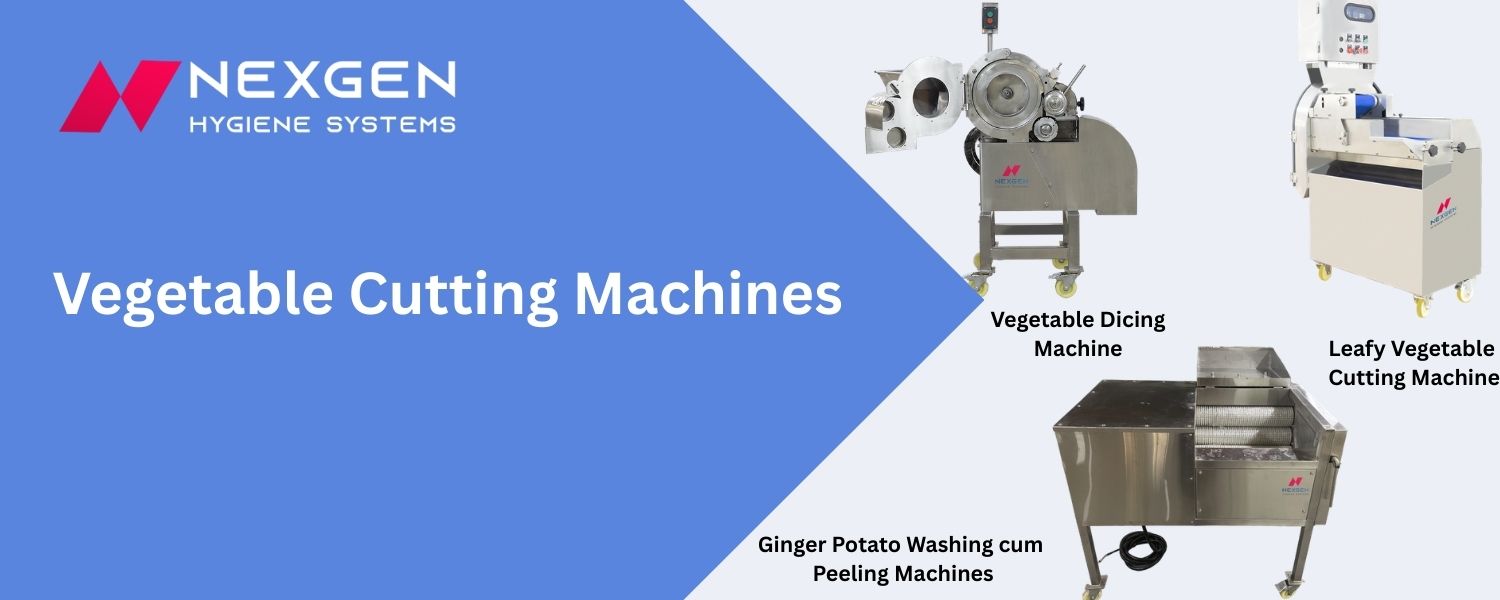
Nexgen supplied a modular suite of industrial vegetable cutting machines engineered specifically for high-volume food processing environments. The system included an automated dicing machine, a slicing machine, and a chopping machine calibrated to handle diverse vegetable types, from firm root vegetables to delicate leafy greens, with fine accuracy and speed.
Key Features:
High-Speed Processing
Processes up to 500 kg of vegetables per hour per machine, dramatically exceeding manual throughput and enabling the facility to scale production on demand.
Precision Cutting
Adjustable blade settings deliver uniform piece sizes and shapes, meeting strict retail quality standards consistently and reducing product rejections.
Versatile Configurations
Quick-change blade assemblies allow operators to switch between dicing, slicing, chopping, and julienne cuts without lengthy setup times, supporting product variety.
Food-Grade Hygiene
Stainless steel construction and easy-clean design ensure rapid sanitation between batches, maintaining compliance with food safety regulations.
Operator Safety
Fully enclosed cutting chambers with safety interlocks eliminate hand-contact risks, reducing workplace injuries and insurance liabilities.
Consistent Output
Mechanized precision ensures batch-to-batch consistency, supporting reliable product quality and reducing variability-related waste.
Implementation
The rollout was carefully phased to minimize disruption to ongoing operations and build internal confidence in the new equipment.
Phase 1 – Facility Assessment & Planning
Nexgen’s engineering team conducted a comprehensive evaluation of the facility’s current vegetable processing workflow, production volumes by vegetable type, existing equipment layouts, and space constraints. They identified the optimal placement locations for the machines and developed a detailed integration plan without interrupting the ongoing work.
Phase 2 – Equipment Installation & Calibration
The cutting machines were installed at the preparation station and meticulously calibrated for the company’s primary vegetable types. Engineers ran extensive test cuts on carrots, cabbages, and leafy greens to optimize blade angle, feed speed, and output consistency. The team also conducted redundancy testing to ensure reliable operation during peak production hours.
Phase 3 – Operator Training & Transition
Comprehensive training was provided to production staff on machine operation, blade changing, maintenance procedures, and safety protocols. Nexgen worked closely with the facility team during the first two weeks of full operation to optimize workflows, troubleshoot any issues, and build operator confidence.
Results
60% Throughput Increase
Daily vegetable processing capacity jumped from 50 tons to 80 tons, enabling the facility to accept larger retail contracts and fulfill peak-season orders without backlogs.
35% Labor Cost Reduction
The company reduced its workforce by 40%, redirecting remaining staff to higher-value quality control and packaging tasks. Overall labor cost dropped 35%.
99.2% Quality Compliance
Pinpoint precise cutting eliminated size-variance rejections from retail partners, achieving 99.2% product compliance on first inspection.
No Safety Hazard Incidents
Elimination of manual knives work resulted in zero knife-related workplace injuries post-implementation, thus improving workplace morale.
Client Testimonial
“We were doubtful at first as vegetable cutting is the most basic (but important) operation and humans can do just fine. But, we were facing the quality and speed issues when orders peaked. Nexgen’s machines deliver the accuracy and speed we could never achieve manually. More importantly, now we can grow our production capacity without worrying about searching for a ton of skilled labour during peak seasons.”
– Operations Director, Food Packaging Company
Conclusion
By implementing Nexgen’s industrial vegetable cutting machines, the food packaging company achieved measurable improvements in production capacity, cost efficiency, and product consistency. The solution freed their team from labor-intensive manual work and allowed them to scale operations and capture new market opportunities; all while maintaining the quality standards that drive customer loyalty.